


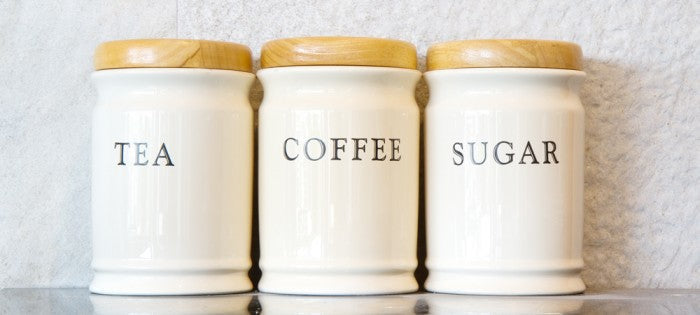
A cup of tea has less caffeine than a cup of coffee: about 50 mg for black tea and 20 to 45 mg for green tea, against about 90 to 95 mg for coffee. Tea is the steeped leaf of the tea plant; coffee is the roasted, ground seed of the coffee plant. Here is how the two compare on history, how they are made, caffeine, taste and what research has and has not shown, plus how to switch if you want to.
At a glance
- Tea comes fromThe leaf and bud of Camellia sinensis
- Coffee comes fromThe seed (bean) of Coffea arabica or Coffea canephora (robusta)
- Caffeine, black teaAbout 50 mg a cup
- Caffeine, green teaAbout 20–45 mg a cup
- Caffeine, coffeeAbout 90–95 mg a cup
Tea vs coffee at a glance
Tea and coffee are both caffeinated drinks from evergreen tropical plants, but tea is an infusion of dried leaves and coffee is an extraction of roasted, ground seeds.Read more
That one difference shapes almost everything else: caffeine, flavor, how you brew and how much variety there is to explore.
| Tea | Coffee | |
|---|---|---|
| Plant | Camellia sinensis, in two main varieties: the small-leaved China plant and the large-leaved Assam plant | Coffea arabica (the preferred variety) and Coffea canephora, known as robusta |
| Part used | The bud and youngest leaves | The seeds of the coffee cherry |
| Harvest | Plucked again and again through the season; in the Nilgiris, on a weekly cycle | Berries harvested once a year |
| Processing | Withered, rolled, oxidized (or not) and dried; usually neither roasted nor ground | Pulped, fermented, washed, dried, then roasted and ground |
| Brewing | Leaf steeped in hot water, or simmered with milk and spice as chai | Ground beans mixed with hot water, or forced through with pressure, then strained |
| Caffeine per cup (about) | Black 50 mg; green 20–45 mg; oolong in between; white on the lower side of green | 90–95 mg |
| Also contains | L-theanine, catechins, theaflavins, and two compounds related to caffeine, theobromine and theophylline | Chlorogenic acids; no catechins |
| Flavor range | Floral, grassy, fruity, malty, smoky, spiced | Roasty, chocolatey, nutty, fruity, acidic |
| Served | Hot or iced; plain, with milk, lemon or spices | Hot or iced; black or with milk |
Caffeine figures are approximate and come from our Tea 101 caffeine posts. The amount in any cup moves with the leaf or bean, how much you use, the water temperature and the brewing time.
The harvest row comes from the Nilgiris, where both crops grew side by side. A third-generation planter there, Cherian P. Matthew, told our blog that coffee berries are harvested once a year while tea has a weekly cycle, which is one reason small growers in the hills moved to tea.
The two drinks also differ in what else is in the cup. A published study of everyday brews, one of the research papers in our tea library, found no catechins in coffee at all; its main plant compounds were chlorogenic acids. Our own training deck adds that, besides caffeine, tea contains two chemically similar compounds, theobromine and theophylline. These are lists of what is there, not claims about what they do.
Where do tea and coffee come from?
Tea is the older drink by far: it began in China, by legend more than 3,000 years ago. Coffee is recorded much later, in the 15th century, in Yemen.Read more
How are tea and coffee grown and made?
Both grow on evergreen bushes in tropical and subtropical hills, pruned low for picking. Tea is made from fresh leaves that are withered, rolled, oxidized and dried; coffee is made from seeds that are cleaned, dried, roasted and ground.Read more
Left alone, both plants would grow into small trees, so growers trim them to a height that is easy to harvest. Sunlight, soil and climate shape the flavor of each, which is why planters spend a lifetime learning their gardens, and why a single estate or single origin is prized in both worlds.
Our training deck sets out what the tea bush likes: temperatures of 18 to 25°C, humidity of 75 to 85%, 180 to 250 cm of rain a year and acidic soil, around pH 5 to 5.8. A young bush needs 3 to 5 years before it is mature enough to pluck. In the Nilgiris the two crops grew on the same slopes, and coffee plants still rub shoulders with tea bushes on some estates.
How tea is made
Pluckers pick the bud and the two youngest leaves, and the leaf goes straight to the estate factory. A skilled plucker gathers 5 to 15 kg of leaf in a 6 to 8 hour day.
In the factory the leaf is withered until soft, rolled to break the cells, left to oxidize (fully for black tea, partly for oolong, barely or not at all for green and white tea) and then dried. The dried leaf is sorted into grades and sold. When a lot reaches us, we check that the finished leaf is dry enough to keep; our buying norm is about 4% moisture.
Unlike coffee, most tea is neither roasted nor ground before you brew it. Tea comes from two main kinds of plant, the small-leaved China type and the large-leaved Assam type; the whole process, step by step, is in How tea is made.
How coffee is made
Coffee cherries are picked by hand and sorted by ripeness and color. In one common method, the fruit’s flesh is removed and the beans are fermented to get rid of a sticky layer of mucilage, then washed and dried. Before brewing, the beans are roasted and ground, mixed with hot water, and the grounds strained out.
Caffeine in tea vs coffee: which has more?
Coffee has more caffeine per cup: Tea 101 puts a cup of coffee at about 90 to 95 mg and a cup of black tea at about 50 mg, roughly half.Read more
Masala chai, which is black tea, sits at about the same level as black tea. Caffeine varies with the leaf, the quantity, the water temperature and the steeping time, so treat these as guides, not lab results.
Here is the surprise: gram for gram, dry tea leaf holds more caffeine than coffee beans. The cup reverses it because of extraction. You use much less tea than coffee for a cup, and steeping draws out only part of the leaf’s caffeine, while brewing coffee pulls out far more.
Research in our tea library puts numbers on it: tea leaves hold about 3.5% caffeine by weight, coffee beans 1.1 to 2.2%. The Tea Research Association at Tocklai, in Assam, found the made teas of North East India at between 3 and 5%. Filter coffee brewed at 20 g to the liter held 310 to 410 mg of caffeine per liter, roughly 80 to 100 mg in a 250 ml cup.
| Drink, per cup | Caffeine (about) |
|---|---|
| Coffee | 90–95 mg |
| Black tea | 50 mg |
| Masala chai (black tea) | About the same as black tea |
| Oolong tea | Between green and black |
| Green tea | 20–45 mg |
| White tea | Generally on the lower side of green; varies |
| Herbal tea (tisane) | None |
Brewing changes the number a great deal. Our 2016 article on caffeine put black tea at around 20 mg after two minutes of steeping and around 50 mg after five. It is a question we first put to readers back in 2016: “Ever wondered how much caffeine is in that cup of tea you’re drinking?” For every type of tea, decaf and the caffeine-free options, see our main guide, Caffeine in tea.
Which tea has the most caffeine?
Among the teas we sell, the strongest are the Assam and breakfast black teas and matcha, all rated “High” for caffeine on our product pages, along with our Kadak Chai. “High” also covers English Breakfast, Irish Breakfast, Classic Earl Grey, Teabox Roasted Darjeeling and our masala chais, while most single-estate Assam and Darjeeling teas are rated “Medium.” With matcha you drink the whole powdered leaf rather than an infusion of it, which is why it rates so high.
The bud matters too. Tocklai found caffeine highest in the bud and falling leaf by leaf down the shoot, from 5.3% in a bud and one leaf to 4.2% in a bud and two. We do not have milligram figures for these teas, and how much you use matters as much as which one you choose.
Green tea vs coffee: how do they compare?
A cup of green tea has about 20 to 45 mg of caffeine, against about 90 to 95 mg for coffee, so it usually has well under half as much.Read more
It is also brewed cooler and shorter than black tea, at 75–80°C (167–176°F) for 2 to 3 minutes, which keeps the caffeine lower and the taste fresh and grassy rather than bitter. Every green tea and green blend we sell is rated “Low” for caffeine, from Darjeeling Green Tea to our jasmine, mint and rose greens.
The flavors are almost opposites. Coffee is roasted, so it tastes of the roast: toasty, chocolatey, sometimes bitter. Most green tea is not roasted in the coffee sense; it is heated just enough to stop oxidation, so it tastes of the leaf: vegetal, nutty, sometimes sweet and floral.
Brewing decides which green tea you meet. Peter Keen, writing for our blog, noted that green tea is preferred mainly for being pleasant and smooth to sip, and yet one of the most common verdicts on it is that it “tastes terrible and is bitter.” The cooler, shorter brew is what keeps green tea fresh and grassy rather than bitter.
Matcha is the exception that coffee drinkers often love: rich, mellow and high in caffeine, and it makes a latte that feels familiar. More in What is green tea? and Black tea vs green tea.
Why does tea’s caffeine feel different from coffee’s?
Many people say the lift from tea feels gentler than from coffee. Part of the reason is simply that a cup of tea has less caffeine; tea also contains L-theanine, an amino acid that coffee does not, and how it interacts with caffeine is still being studied.Read more
The caffeine itself is the same molecule. “Theine,” a name you still see on old tea packets, is simply an old word for the caffeine in tea, and it is chemically identical to the caffeine in coffee. Our training deck explains why it is in the leaf at all: the tea plant makes caffeine, and its relatives theobromine and theophylline, as a way to ward off insects and other animals.
Some practical differences are easy to see. A cup of black tea delivers roughly half the caffeine of a cup of coffee, and green tea less, and tea is often sipped slowly over a long pot rather than drunk quickly.
You can also steer tea’s strength more finely than coffee’s: less leaf, cooler water or a shorter steep all give a lighter cup. The size of the leaf counts as well. The tea and coffee trader Ian Bersten told our blog that “particle size is the chief determinant of flavor extraction, not time,” so fine broken leaf gives up its strength far faster than whole leaf.
On L-theanine itself, research is ongoing and we make no claims for its effects.
Is tea healthier than coffee?
We do not rank one above the other. Both tea and coffee have been studied for decades, and both contain caffeine and plant compounds (tea’s catechins and theaflavins, coffee’s chlorogenic acids), but research does not give a simple winner, and we make no health claims for either.Read more
Much of the research on both drinks is observational: it follows what large groups of people drink and what happens to them, which can show links but cannot prove that the drink caused them. Results also differ with how much people drink and what they add, from milk and sugar to cream and syrup.
Peter Keen, who wrote about tea and health for our blog, put it bluntly: when an ad says a health link is “proven,” it isn’t, and “tea is a drink, not a pill.”
If you have a health condition, are pregnant or take medication, ask your doctor what suits you. What research has and has not shown about tea is in Health benefits of tea, and the most common overstatements are taken apart in Tea and health myths.
Our senior editor at the time, Aravinda Anantharaman, answered the question under our interview with Ian Bersten: “We feel you should drink coffee or tea or both for pleasure.” Neither, she wrote, is an antidote for ailments, “but choose a good quality tea or coffee.”
How do tea and coffee taste different?
Coffee’s flavor comes mostly from roasting, so most coffees share a roasted base; tea’s comes from the leaf, the garden, the season and how it was made, so it ranges from pale, floral and grassy to dark, malty and smoky.Read more
That range is tea’s great strength. Our 2014 blog post making the case for tea, Why tea always trumps coffee, put it this way: there is a tea for every taste and mood, “strong or light, hot or cold, sweet or astringent, black or green, high-caffeine or low-caffeine.” And much like wine, each year brings new teas: a spring Darjeeling and a summer Darjeeling from the same estate taste different, and so do two years of the same garden. See What is first flush tea? for how one season can taste.
Tasters in both worlds work in a similar way. The cupping form our team adopted in 2014 was adapted from a specialty coffee form, and it scores each tea from 6 (Good) to 9 (Outstanding); a lot needs a sensory score above 7 to pass our checks.
Tea is also an easy partner for food. The same post points out that a delicate Darjeeling first flush goes well with seafood, egg dishes and rich desserts like a crumble, and that tea is just as happy with finger food. Coffee pairs well with desserts, it argued, but its strong flavor can overpower savory food.
Taste is also personal. One of our writers grew up in a Madras filter coffee household, watching her parents share a cup at 7 a.m. every day, and hated coffee’s bitterness from the first sip. At 14 she made her first chai, strong Assam tea with cinnamon, cardamom and ginger, and found it “spicy, soothing, sweet and refreshing, all at once.” Her story is Why I love tea.
Can you love both?
Plenty of people do. The Australian tea and coffee trader Ian Bersten, author of Coffee Floats, Tea Sinks, told our blog he drinks three or four cups of tea and two of coffee a day, and that blindfolded, “they both give me pleasure.” His one firm view on tea: “Tea is more refreshing.”
He roasts his own coffee, 600 grams at a time, in a roaster he invented, and his ideal tea is Darjeeling fannings brewed for 30 seconds and served with milk and sugar. The full interview with Ian Bersten is on our blog.
Can you mix coffee and tea?
Yes. Coffee and tea brewed together is drunk in several cultures: in Hong Kong it is called yuanyang, made with about three parts coffee to seven parts sweet milk tea.Read more
Our blog called the family of drinks “cofftea.” Its other names include kopi cham in Malaysia, spreeze in Ethiopia and teafee in the USA. Yuanyang means “a pair of mandarin ducks”: the male and female look completely different but mate for life, an unlikely but complementary pair.
Nobody agrees on who invented it. Our writer Adeline Teoh found one claim for Frank Weston, experimenting in the Netherlands in 1993, and another for a Cistercian nun who began combining the drinks in 1936, about when the drink appeared on the streets of Hong Kong. She first met it as a teenager, when a family friend put a heaped teaspoon of instant coffee and a tea bag in one mug.
A café “dirty chai,” a chai latte with a shot of espresso, is a modern cousin, though Teoh found it less a cofftea than a flavored coffee; see Dirty chai.
Teabox has made its own versions. Our 2015 range of iced tea blends included a coffee flavor, alongside mint, pineapple and peach. Teabox later made the Kopi Chia iced tea, in which “the distinct taste of coffee blends smoothly with tea,” for “times when you can’t decide between tea and coffee.” Our recipe for a Kopi Chia cocktail stirred 120 ml of the tea concentrate with 35 ml of almond milk, 40 ml of whiskey, 7 ml of brown sugar syrup, a dash of cinnamon and ice, in a glass rimmed with coffee and cinnamon powder.

How to switch from coffee to tea
Start with a tea that feels familiar: a strong, malty Assam or breakfast black with milk, or a kadak chai, in the morning; then try lighter teas later in the day.Read more
Tea vs coffee FAQ
Does tea or coffee have more caffeine?
Coffee, per cup: about 90 to 95 mg, against about 50 mg for black tea and 20 to 45 mg for green tea. Gram for gram, dry tea leaf holds more caffeine than coffee beans, but steeping draws out only part of it. Caffeine varies with the leaf, quantity, water temperature and steeping time.
Which tea has the most caffeine?
Strong Assam and breakfast black teas and matcha, all rated “High” for caffeine on Teabox product pages, along with kadak chai. With matcha you drink the whole powdered leaf, and with any tea, more leaf and a longer steep mean more caffeine.
Can tea replace coffee?
For many people, yes. A strong Assam or breakfast black with milk, a kadak chai or a matcha latte gives a full-bodied morning cup with less caffeine than coffee. Start with those, then explore lighter teas for later in the day.
Is green tea a good substitute for coffee?
It is much lighter: about 20 to 45 mg of caffeine a cup against about 90 to 95 mg for coffee, with a fresh, grassy taste rather than a roasted one. If you want something closer to coffee’s strength, try matcha or a strong black tea.
Is tea healthier than coffee?
Research does not give a simple answer, and we make no health claims for either drink. Both have been widely studied. If you have a health condition, are pregnant or take medication, ask your doctor what is right for you.
Can you mix coffee and tea?
Yes. In Hong Kong, yuanyang mixes about three parts coffee with seven parts sweet milk tea; similar drinks are called kopi cham in Malaysia and spreeze in Ethiopia. A dirty chai, a chai latte with a shot of espresso, is the café version.
Keep reading
Sources
- Teabox Tea 101: Tea vs coffee; Caffeine in tea; Black tea or green tea
- Teabox blog (Still Steeping): Why tea always trumps coffee (2014); Why I love tea (2015); Tea or coffee? I swing both ways! (2015, interview with Ian Bersten, including the editor’s comment of 2016); When King Coffee Bowed Out to Tea (Nina Varghese, 2016); Green tea and weight loss: Lessons from jockeys, dancers and athletes (Peter Keen, 2016); Wake Up to the Year of the Rooster (Adeline Teoh, 2017)
- Teabox blog (Still Steeping) stories: Why Tea Is a Religion and Coffee Isn’t, 2015; Would you like some coffee in your tea? (Adeline Teoh), 2016; Caffeine in Your Tea? Stop Worrying! (Peter Keen), 2016; Tea vs health: You be the judge and the jury (Peter Keen), 2016
- Teabox product data, October 2026: caffeine ratings (new caffeine field) and tasting notes
- Teabox Drive: Teabox internal document; Teabox internal document, 2014; Teabox internal document, 2015; photos as credited
- Published research held in the Teabox knowledge repository: M. N. Dev Choudhury, F. Rahman and B. C. Barbora, Teabox internal document, Two and a Bud (Tocklai); D. Komes et al., Teabox internal document, Czech J. Food Sci. 27 (2009); Lakenbrink, Engelhardt et al., Teabox internal document, J. Agric. Food Chem. 48 (2000)
- Teabox on Instagram (@teabox.tea): iced tea range, Jun 2015, caffeine question, Jul 2016, Kopi Chia iced tea, May 2017, Kopi Chia cocktail, May 2017

Leave a comment
All comments are moderated before being published.
This site is protected by hCaptcha and the hCaptcha Privacy Policy and Terms of Service apply.