


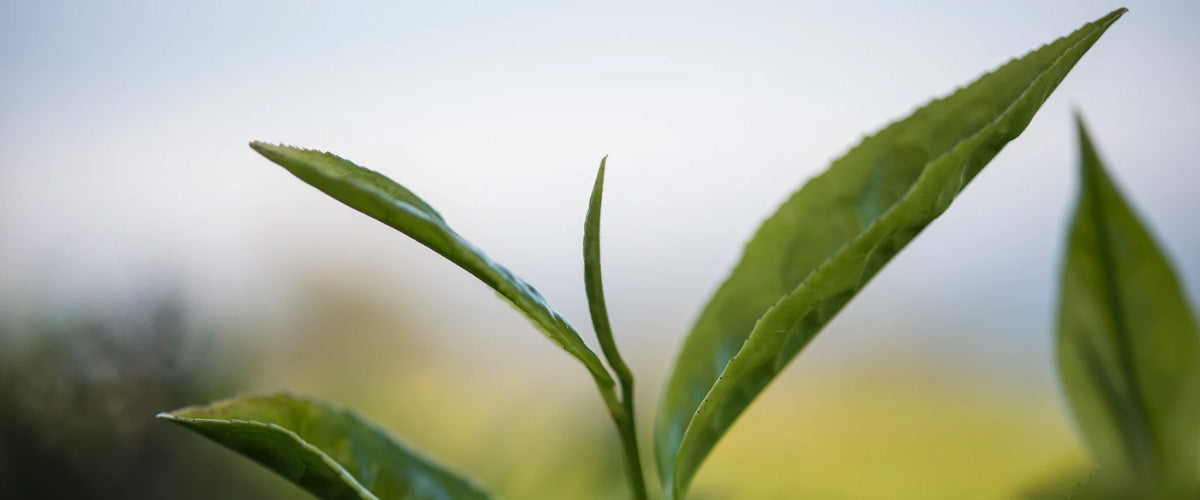
The tea plant, Camellia sinensis, is an evergreen shrub in the same family as garden camellias, with glossy, slightly serrated leaves. Its Latin name simply means “the camellia from China.”
The tea writer Peter Keen, writing for us, told the story of the name with a smile: botanists first found the plant only in China, “so we called it the Chinese camellia,” and when a second variety turned up in India they had to “distinguish the Chinese Chinese camellia from the Assam Chinese one.”
What is the tea plant? Camellia sinensis explained
The tea plant is Camellia sinensis, an evergreen shrub of the camellia family; left alone it flowers and can grow into a tree, but on an estate it is pruned into a waist-high bush.Read more
The tea bush and the tea plant are the same thing; “tea bush” is just what planters call it once it is pruned and planted in rows. (Tea tree oil, despite the name, comes from an unrelated Australian plant.)
Our own training notes describe it as “an evergreen with a small white flower” that also sets tea seeds. There is one species and two varieties. Some older Teabox notes call the Assam plant a separate species; it is a variety, Camellia sinensis var. assamica, as Tea 101 says.

A bush that lives for a century
In the wild, wrote the tea writer Peter Keen in our 2016 “biography” of the bush, Camellia sinensis “will flower, just like decorative camellias, and can grow as high as 100 feet and live for well over 100 years.”
Tea farms keep it at just over a meter, shaped into a flat “plucking table” so pluckers can reach the new growth. A bush typically has a productive life of about 60 years. Our 2023 training deck says the same in our own words: tea plants “can live for more than a 100 years and can grow into tea trees, if not pruned on a regular basis.”
Many Darjeeling gardens still pluck Chinary bushes more than 100 years old. We buy from several of them:
- Goomtee: its Muscatel Valley section is planted with Chinary bushes more than 130 years old.
- Margaret’s Hope: vintage Chinary plants, some as old as 100 years, now treated as heritage varieties and a rarity.
- Giddapahar: a Kurseong garden making tea since 1881, whose legacy “lies in its century-old China bushes.”
- Kangra: in the Dharmsala Tea Company’s gardens, “most bushes are over 100 years old,” Anirudh Suri told us in 2017.
When our team visited the Singpho village of Margherita in Upper Assam, families were plucking from backyard tea trees at least 8 to 10 feet tall, taller than any bush our buyer Ravi Kothari had seen. Ravi was then our procurement manager, and the visit lasted three days at the Singpho Eco Village.
Old bushes are a mixed blessing. They give character, but they yield less, and Keen noted that gardens need to replace about 2% of their bushes a year to stay healthy, while the world has managed only about 0.7% for decades.
Which part of the tea plant is plucked?
Only the youngest growth makes fine tea: the unopened bud at the tip of each shoot and the one or two leaves below it.Read more
Tea 101 names each part in order of quality:
- The bud: the flowery pekoe.
- The first leaf: the orange pekoe.
- The second leaf: simply pekoe.
- The third leaf: first souchong, or pekoe souchong. Lower leaves, the souchong, congou and bohea, are coarser and go mostly into CTC.
A plucking is named by how much of the shoot it takes:
- Imperial: a bud and one leaf.
- Fine: a bud and two leaves, the classic two leaves and a bud.
- Ordinary: a bud and three leaves.
Older, coarser leaves go mostly into CTC tea. These same words reappear on labels as grades such as FTGFOP; see Tea grades explained.
How often a bush is plucked
Only the top inch or two of a mature bush is taken, and in the growing season a new flush of shoots appears every 7 to 15 days. Gardens pluck each section in rounds of 3 to 10 days, depending on the region. At Halmari in Assam, Ravi Kothari found plucking rounds “strictly restricted to 5 or 6 days.”
Slow growth is good for the cup. Our training module notes that leaves slowed by cold weather “will produce better flavored teas,” which is one reason high gardens and spring teas are prized.
How little one bush gives
In Darjeeling, a single kilogram of leaf for processing takes about 20,000 shoots, plucked by hand on slopes of 40 to 60 degrees, and each bush gives a total of about 40 cups of tea a year. The finest teas take even more patience: when Arun Kumar Gomden made the first Silver Tips at Thurbo in 1979, a worker could pluck only about 100 g of buds a day.
Those buds show up in the cup and in the leaf. Our tasters call a tea “tippy” when it has silvery or golden tips, which are simply unopened buds from the bush.
What happens to the tea bush through the year?
The bush grows in bursts called flushes, from spring to autumn, then rests through the cold months, when gardens prune it.Read more
In North India it rests through the cold months, and planters prune it then, generally from December to February, when growth is slowest and the plant’s reserves are highest. An experienced planter times the pruning after weighing the climate, soil, crop and quality the garden wants, how the crop falls across the seasons, and the risk of pests and disease.
In Darjeeling, as the temperature drops below 12°C, the bushes go into winter dormancy; by late February or early March, with brighter weather and more sunshine, “young green shoots start coming up” to greet the spring.
Winter on the estates
- The last pick: the Tea Board of India sets the last day of picking in Darjeeling; in 2023 it was 11 December, after which the bushes were pruned for spring.
- No harvest: in Assam and the Dooars, bushes are pruned from the second half of January to the end of February, and there is no harvest at all; in 2022 that pause sent our Kadak Chai out of stock.
- A starch test: at Margaret’s Hope, assistant manager Anup Khondo told us the estate tests the starch in its shoots every year, because only a plant with enough reserves “can survive hard pruning.”
- The Nilgiris: in the south it never gets cold enough for dormancy; instead frost settles on the bushes and slows them down, which gives the winter frost teas.
What each flush gives
Each flush gives the same garden a different tea; the full calendar is in Seasons of tea. The flushes are not equal in size. Our 2017 training notes put the monsoon at about half of a garden’s year, 50%, against 20% for summer, 18% for spring and 12% for autumn, and say we buy only in spring, summer and autumn.
By November the bushes slow their output as they head for winter; it is the season when our team travels Darjeeling and Sikkim tasting fresh autumn cups.
Insects, good and bad
Caffeine is part of the bush’s defense; Keen called it “a natural pesticide.” Not every insect is an enemy: tea jassids and thrips are counted as good bugs, and the plant can sense not only the damage being done but which insect is doing it. In Darjeeling, jassids pierce the leaves and stems to suck sap, and the bush’s response to that bite is part of what gives the prized summer muscatels their flavor.
Chinary and Assam: the two tea plant varieties
Two varieties of Camellia sinensis are grown for tea: the small-leaved China plant, var. sinensis, which Indian planters call Chinary, and the large-leaved Assam plant, var. assamica.Read more
Tea 101 counts only these two as commercially viable, along with the many cultivars bred from them.
| Chinary (var. sinensis) | Assam (var. assamica) | |
|---|---|---|
| Native to | Northern Burma and China’s Yunnan and Sichuan | The forests of Assam and northeast India |
| Size | A shrub of about 2 meters | Can grow into a small tree if left unpruned, about 10 to 13 meters |
| Leaf | Small, dark, almost leathery, mildly serrated | Large, thin, bright, with a tapering tip |
| Grown in India | Darjeeling and other high gardens | The Assam valley and the plains |
| In the cup | Light, floral, aromatic | Bold, malty, full-bodied |
| Try | Castleton Spring Chinary Black | Halmari Summer Black |
The 10 to 13 meter figure for the Assam tree is from our 2017 training notes. Leaf size explains much of the cup: in Kausshal Dugarr’s words, “larger leaves yield a stronger flavor, while smaller leaves render a stronger aroma.”
Chinary in India
Chinary was first tried in Assam, then planted in the high gardens of Darjeeling and Kangra, where it grew far more healthily. Tea planting in Darjeeling began officially in 1841, when Archibald Campbell planted a few Chinary seeds near his house, and by 1847 there was an official nursery. In Kangra the Chinese bushes still do well; Anirudh Suri told us they fare better and yield more there than in Darjeeling.
The Darjeeling gardens we buy from still name the bush on the label: Castleton has heritage China bushes, Margaret’s Hope is planted predominantly with Chinary, and Jungpana’s China bushes grow on south-facing slopes at 4,000 to 4,500 feet.
Chinary is less predictable than a clone, and tasters like it for that. Veteran Darjeeling tea maker and master taster Arun Kumar Gomden says muscatels come from Chinary bushes planted more than a century ago, whose “flavors differ significantly from place to place,” while clonals “more or less produce the same flavor profiles, with varying intensities.” In his early years, he recalls, the trade used no finer names: “It was always chinary or clonal.”
Where does the Assam tea plant come from?
The Assam plant is native to India: it grew wild in the forests of the northeast, where the Singpho people brewed it long before the British began planting tea there.Read more
India’s own variety
The Assam variety is India’s own. Wild Assam tea grew in the northeast long before the British arrived, and the Singpho people of Upper Assam were already brewing it.
In 1823 a Singpho chief showed the Scottish trader Robert Bruce how his people made tea from the bush; Bruce’s brother Charles later sent samples to the botanical garden in Calcutta, and the plant was later named Camellia sinensis var. assamica. Robert Bruce had found the plants growing wild near Rangpur while on a trading mission, and he died a few years later without seeing the plant properly classified.
That is why we call Assam “the land of original Indian tea.” We wrote the same of the valley in 2015: “it’s here that the original Indian tea (Camellia sinensis assamica) grows.” More in Assam tea.

How the Singphos made tea
The Singpho method was simple. They plucked the tender leaves, dried them in the sun, left them out in the night dew for three days, then packed them into hollow bamboo and smoked them. When our team stayed in Margherita in 2016, the families still roasted the leaf in a wok and sun-dried it before packing it into bamboo, and served the tea with a piece of jaggery on the side. One of the team described it as “Green, smoky and like nothing I’d ever tasted before.”
Why Assamica won in Assam
The British first planted Chinese seed in Assam, but those plants did not suit the Assam terroir, so the local assamica was welcomed instead. Commercial planting began in Upper Assam in the late 1830s at Chabua, whose name comes from “Chah Bowa,” Assamese for “tea planting.”
India’s first cloned crop came from this local stock. It was raised at Tocklai from seeds collected at the Cinnamara estate of Maniram Dewan, India’s first commercial tea planter.
What are clonal tea plants?
A clonal is a tea bush grown from a cutting of one chosen parent, so every plant in the row is identical, unlike seed-grown bushes.Read more
Seed-grown bushes vary from one plant to the next, so growers also plant clonals: bushes propagated from cuttings of one chosen parent, so every plant is identical, down to its aroma.
It is the same vegetative propagation that gave us so many apples and roses. Cuttings, usually of a single leaf, are rooted in a nursery, and one mother bush may give only 50 to 300 healthy cuttings a year. Nothing is added to the plant’s genes, so, as Peter Keen put it, “The clonal path is GMO-free.”
The names on the label
Tea 101 names these among the clonals used in India:
- AV2: known for highly fragrant teas.
- TV1: high quality, low yield.
- TTRI 2: quality orthodox tea.
AV2 stands for Ambari Vegetative 2. Darjeeling clones take their names from the gardens that bred them: the high-quality B157 is from Bannockburn and P312 from Phoobsering. AV2 is one of around thirty Darjeeling clonals, with a subtle floral lift often described as “melon,” and a new clone typically takes at least seven years to reach full production.
Our own teas show the mix. Our Badamtam Spring Moonlight White is made from a blend of the fragrant AV2, P126 and B157 clones. Gopal Upadhayay, who led our procurement team in 2016, has said his favorite Darjeeling is a cup made from the AV2 clone.
Where clones came from
The mother plant of India’s first cloned crop, an Assam-China hybrid developed in 1949, still grows at the Tocklai research station in Jorhat. In 2016 Tocklai advised more than 1,076 estates across India, and its plant breeder Devajit Borthakur told our team its clones suit both CTC and orthodox black tea.
Gardens that grow a mix
Many gardens grow a mix. In 2016 Namring, in Darjeeling, described its bushes as about six-tenths Chinese, three-tenths clonal and one-tenth Assam hybrid, chosen for a mellow muscatel flavor. Its gardens run from about 3,000 feet to 5,500 feet at the highest point, planted with China, clonal and Assam hybrid bushes.
Margaret’s Hope, by contrast, is about 90% Chinary, with AV2, Takdah 7-8 (which gives the most tips) and the N-436 hybrid making up the rest. Giddapahar, long a Chinary garden, has added young clonal plantings in recent years.
The full comparison is in Chinary, Assam and clonal tea plants.
Can you grow a tea plant at home?
Yes. Camellia sinensis grows well in a large pot or a sheltered garden bed, as long as it has acidic, free-draining soil, regular water, good light and protection from hard frost.Read more
It is grown much like any garden camellia, and the Chinary type, being smaller and hardier in the cold, is the easier choice for most homes. Our training deck sums up what the bush wants on an estate: acidic soil, a tropical to subtropical climate of about 15 to 30°C, high humidity and heavy rain. The closer you get to that, the happier it is.
- Soil and water: use an acidic, lime-free mix, keep it evenly moist, and never let the roots stand in water: waterlogging kills tea bushes on estates too.
- Light: give it bright light; in a hot climate, some afternoon shade, as estates give their bushes with shade trees.
- Cold: the bush rests in cool winters, but long hard frosts can damage it; bring a pot indoors or into a sheltered spot.
- Pruning: trim it to a compact shape, and pinch out the tips to encourage the bushy new shoots you will pluck. Estates cut their bushes back on a cycle of one to two years.
Tea plant seeds or a cutting?
Tea plant seeds are easy to find, but every seedling is a little different, which is exactly why estates plant clonal cuttings for consistency.
- A nursery plant: a young nursery plant is the faster route.
- A seed: a seed gives you a unique bush.
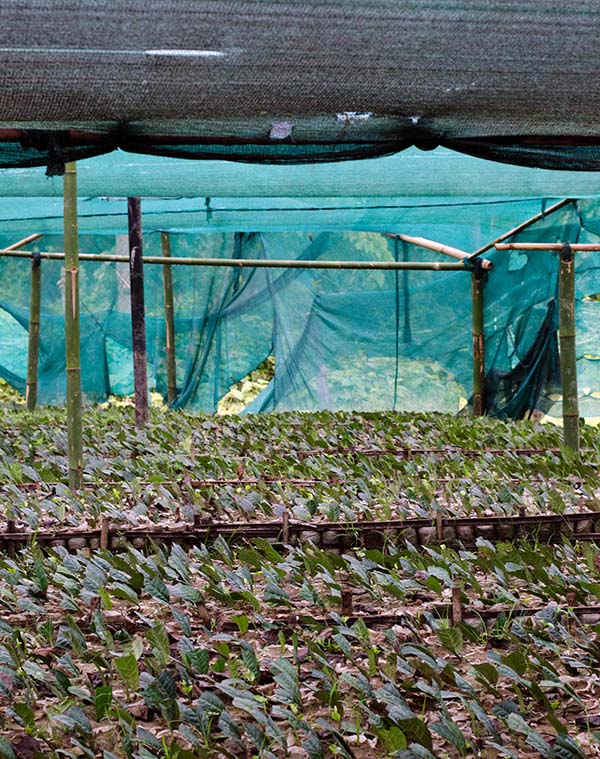
Either way, let it establish for a few years before you pluck regularly. On estates, a sapling takes 12 to 18 months in the nursery to become ready for the field, and the first two leaves and a bud are plucked from the third to fifth year after planting, depending on the region. A full commercial harvest takes far longer: on estates, the lead time from seedling or cutting to a full harvest is at least ten years.
Making your first batch
Once it is growing, pluck the bud and top two leaves and try a small batch.
- Simple green tea: heat the fresh leaf briefly in a dry pan, then roll and dry it.
- Rough black tea: let it wilt, roll it until the juices show, leave it to darken, then dry it.
- Simple white tea: spread the buds on a mesh in a very thin layer and leave them to dry in the sun or the shade, as our training notes describe for white tea.
It will not taste like an estate tea, but it shows you, in your own kitchen, how one leaf becomes many teas. The Singpho families of Margherita still make their tea at home in much this way, roasting the leaf in a wok and drying it in the sun.
Keep reading
Sources
- Teabox Tea 101: An introduction to tea; Chinary, Assam and clonals: Indian tea plants; How tea is processed and classified; Types of tea; Caffeine in tea; A beginner’s guide to herbal tea
- Teabox blog (Still Steeping): How is tea made? (2015), Where can we find the earliest reference to tea? (2016), A tour of the Tocklai Tea Research Institute (2016), Assam Diaries: Margherita, the Singphos and coin tea (2016), The Teabox team in Assam (2016)
- Teabox blog (Still Steeping): The beginner’s guide to choosing a Darjeeling (2017), In Kangra, for a tour of the tea gardens (2017), In Assam for the summer flush (2015), A secret tea garden in the clouds (2015)
- Teabox blog (Still Steeping): A Tryst with History (2020), The Muscatel Master (2021), Tea Diversity – How nature speaks through the flavors of tea (2020), Going clonal: how about a nice cup of AV2? (2016)
- Teabox blog (Still Steeping): A Biography of the Tea Bush, 2016; The chemistry of tea: a lab, not a leaf, 2016; Clonals: the tea of the future, 2016; The true colors of the white tea, 2016; The delight of Margaret’s Hope, 2016; In defense of the tisane, 2015; White tea: a quick and dirty guide, 2014; Black tea: all you need to know, 2014
- Teabox internal documents (Google Drive): Teabox internal document, 2017; Teabox internal document, 2017; Teabox internal document, 2017; Teabox internal document, 2020; Teabox internal document, 2023; Teabox internal document, 2023; Teabox internal document, 2021; photos as credited
- Teabox product descriptions, 2026 season: Special Spring Silver Needle White, Glenburn Spring Moonshine Oolong, Castleton Spring Chinary Black, Halmari Summer Black, Giddapahar Spring Chinary and Spring Clonal Black, Okayti, Margaret’s Hope and Jungpana Spring Chinary Black, Badamtam Spring Moonlight White, Mangalam Gold Summer Black, Kadak Chai, Kashmiri Kahwa Saffron Green, Hibiscus Lemongrass Tisane, Pure Chamomile
- Teabox on Instagram (@teabox.tea): Singpho and Bruce, Jun 2020, Margaret’s Hope heritage bushes, Jul 2020, iced hibiscus, Jan 2020, pruning, Mar 2021, 2.5 g samples, Apr 2021, Castleton tasting session, Jun 2021, terroir, Jun 2021, horizontal and vertical tasting, Jul 2021, Mangalam oxidation trial, Sep 2021, soils, Sep 2021, autumn slowdown, Nov 2021, Kadak Chai and pruning, Jan 2022, Assam near sea level, Feb 2022, one-plant myth, Mar 2022, wild Assam tea, Aug 2022, Darjeeling dormancy, Nov 2022, last picking day, Dec 2023, Nilgiri frost, Feb 2016, Namring bushes, Feb 2016, original Indian tea, Jul 2017
- Kausshal Dugarr on X (@Teapreneur): one plant, Apr 2022, good bugs, Jan 2022; Teabox on YouTube: The true story of tea cultivation in India

Leave a comment
All comments are moderated before being published.
This site is protected by hCaptcha and the hCaptcha Privacy Policy and Terms of Service apply.