


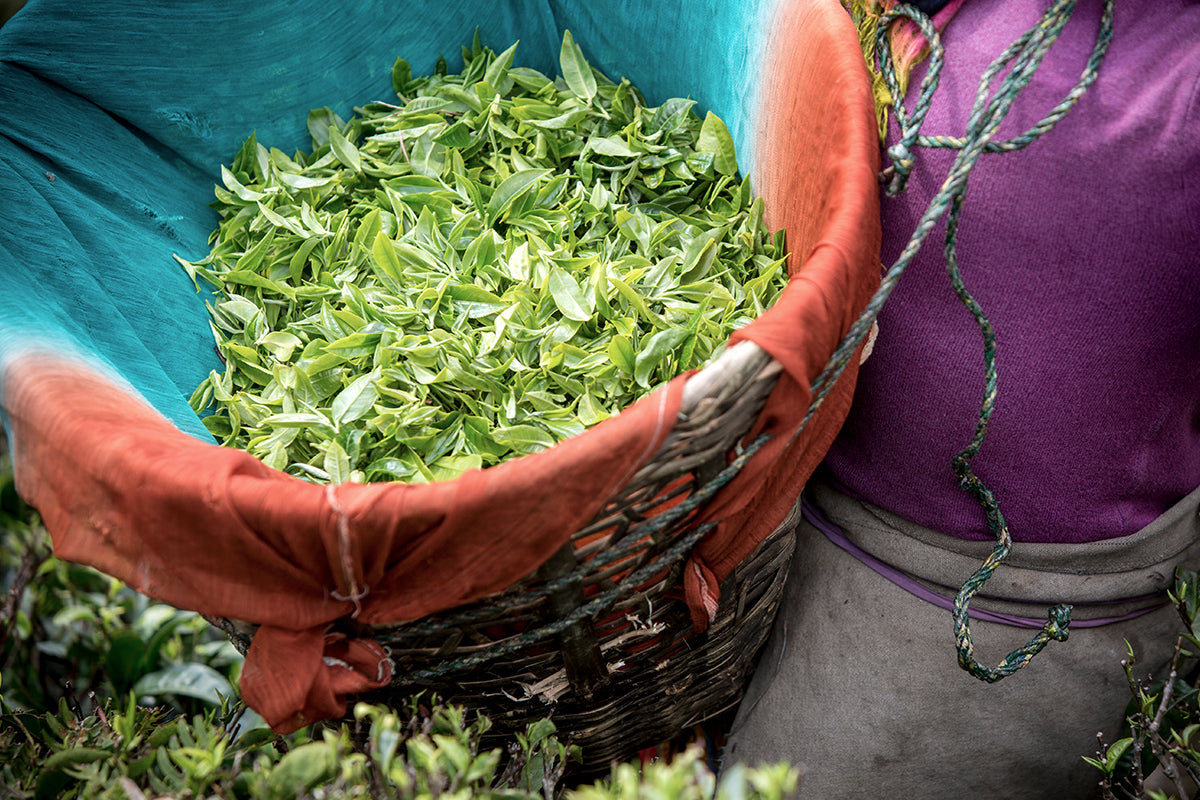
Darjeeling has five seasons of tea: the first flush in spring, a short in-between flush, the second flush in summer, the monsoon flush and the autumn flush, after which the gardens rest for winter. Our facility in Siliguri sits about an hour and a half from the gardens, so we taste every one of these seasons as it happens.
This page follows a Darjeeling year flush by flush, with the dates, weather and tasting notes from our own buying. For the whole Indian tea year, including Assam and the Nilgiris, start with Seasons of tea.
When is the Darjeeling first flush?
The first flush, or spring flush, is picked in spring, usually from March to mid-April, and in an early year from late February; it gives the lightest, most floral and most expensive Darjeeling of the year.Read more
After a winter without plucking, “the magnolias bloom, and the rhododendrons and chamomile bloom, and it’s officially spring,” and the first flush begins, usually in March. Buyers sign forward contracts before winter is out, and the valley buzzes over which garden will make the first tea.
The leaf is young and tender, lightly rolled and still visibly green, and the cup is pale, brisk, floral and fruity. Darjeeling first flush commands the highest prices at auction, and only a limited quantity is made: the bushes flush within two or three weeks and are plucked in three or four rounds. It is sometimes called the Easter flush. More in What is first flush tea?, and for spring in the hills, our postcard from Goomtee.
Why some gardens are always first
Position decides a lot. Sumon Majumder, who ran Namring, told us its slopes catch the warm breeze from the plains earlier than many hill gardens in February and March, so its buds break that much quicker. In his view the first flush is known for “discipline” and is freshest if harvested by Easter.
Namring also sends garden-fresh samples by air to win forward contracts; buyers in Hamburg call air-freighted fresh tea “flug tee.” In 2015 its 90 kg first flush lot was judged by one UK importer the best among all 87 Darjeeling gardens, and it sold at the London auction for Rs 40 lakh.
The first samples come early. Our first cup of First Flush 2021 arrived from Goomtee on 27 February, a smooth, light-bodied clonal tea, and our tasters expected the notes to grow as the weather brightened.
How long spring lasts
The length of the season depends on the weather after the first rounds. In 2023 the quality period lasted only until about 20 April; after it, very hot and humid days with no rain sent the bushes into early banjhi, a dormant spell when the shoots stop making buds.
In 2024 the weather improved and the estates recovered well, extending the season late into May with quality yields. That spring our team tasted more than 150 samples a day from more than 30 estates across all the valleys, and our limited edition lots from Risheehat and Okayti sold out in under 48 hours.
Our own spring buying follows the gardens, not the calendar: our first 2026 lot, the Upper Namring Spring Clonal, was picked on 20 and 21 February, and our last, a Castleton chinary, on 1 June. The dates for every lot are in When we pick each flush.
What is the in-between flush?
The in-between flush is a brief burst of growth between spring and summer, around late April and early May, lasting about two weeks.Read more
Around late April and early May, after the first flush and before the second, comes a brief in-between flush lasting about two weeks. After it, the bushes rest briefly before summer growth.
That pause is what the gardens call banjhi, an intermittent dormancy when the shoots stop making buds for a while. Our 2017 Darjeeling guide counts in-between teas among the labels you can “do better” than.
In a hot, dry spring the pause comes early: in 2023 banjhi set in soon after 20 April. Good showers through May then raised hopes of an early summer that year.
When is the Darjeeling second flush?
The second flush, or summer flush, is the summer harvest, from late May into June, and it gives the darker, sweeter, amber teas, including the grape-like muscatels.Read more
From late May into June, the warmer days (about 15 to 22°C in Darjeeling) bring fuller, darker leaf and a sweeter, amber cup. This is the season of the muscatel, the grape-like flavor that makes a few Darjeeling summer teas famous. Read more in Second flush tea and muscatel, or set spring and summer side by side in First flush vs second flush Darjeeling.
The muscatel window
The muscatel itself has a short window: every garden has only about 12 to 15 days when the conditions are right. Our 2019 notes tie it to a small insect, the jassid, which feeds on the young shoots for about two weeks in June; the leaf grows more slowly and its flavor concentrates.
The word itself is a Darjeeling invention of the mid-1980s: Arun Kumar Gomden, the veteran tea maker and master taster, named the muscatel teas at Castleton. “I perused the dictionary and settled on the word muscatel, which meant ‘grape’ or ‘fruity’,” he told us.
Three summers in our notes
- 2019, late: modest showers and cloud cover in early June held the season back, and the famous muscatel gardens made their best teas only in the second fortnight of June, once the sunshine improved around 20 June.
- 2023, early: good showers through May raised hopes of an early summer, and the first samples came from Singbulli, Jungpana, Selimbong, Seeyok, Giddapahar and Singell.
- 2024, on time: bright June sunshine with fog brought early samples from Singbulli, Risheehat, Snowview, Singell, Giddapahar and Puttabong, and our team judged the next 10 to 15 days, hot and humid with night rain, as crucial.
Our summer buying runs well past June. In 2026 our first Darjeeling summer lot, a Giddapahar chinary, was picked on 8 and 9 June, our Castleton Summer Muscatel on 24 and 25 July, and our last, from Risheehat, on 24 and 25 August.
What is the monsoon flush?
The monsoon flush is the rainy-season harvest, from July to September: plenty of leaf, but heavier and less delicate, so most of it becomes strong CTC tea for blends.Read more
After summer come the rains, from July to September. The monsoon flush gives plenty of leaf, but it is more mature and lacks the delicacy of spring and summer, so it makes a strong-bodied tea. Most of it, in Darjeeling, Assam and the Nilgiris, is made by the CTC method for blends such as masala chai. See Orthodox vs CTC tea for the difference.
It is also the biggest crop. Our training notes put the rains at about half of a garden’s year, against 20% for summer, 18% for spring and 12% for autumn, and we buy our Darjeelings only from the other three seasons.
For the people in the gardens, the busy stretch runs from April until the Durga Puja holidays in September or October, when the monsoon is ending and the autumn flush is about to start.
When is the autumn flush?
The autumn flush, also called the third flush or fall flush, is the year’s last harvest, from mid-October into November and in some years into early December, and it gives woody, mellow, rounded teas.Read more
Autumn in India is short, “the season of retreating monsoon, a pause before winter kicks in.” The third harvest of the year comes from mid-October into November, sometimes running into early December, as the soil dries and the bushes slow down before their winter rest.
Darjeeling autumnals are woody and mellow, with “a subdued and understated refinement”: rounded teas with less sharpness than spring or summer, good for a quiet evening. Goomtee and Thurbo are among the estates known for them. “Considered the rare final harvest before the mountains go to sleep,” autumnal teas are “less floral and delicate than the Spring flush… more fruity with slightly sweet, nutty undertones and mellowness, making it the most readily palatable of all Darjeeling teas.” In season, pluckers wake at 4 am to bring in the last leaves. The full story is in Autumn flush tea.
Why autumn is so short
Our 2016 autumn notes give the window as “not more than 3-4 weeks before winter sets in.” Our estate notes from November 2021 explain why: the soil is drier, and the bushes put out less leaf as they move toward their winter rest. “It’s as if the bush is looking forward to its rest.”
On that 2021 trip our team spent two days across Darjeeling and Sikkim tasting fresh autumn cups at Goomtee, Jungpana, Giddapahar, Bermiok, Singbulli and Oaks. In the tasting room the numbers add up fast: we receive about 60 autumn samples a day and make more than 220 cups before we shortlist a single tea.
When plucking stops
Plucking runs right up to the cold. In 2023 the Tea Board of India named 11 December as the last day of picking in Darjeeling, after which the bushes were pruned for spring; our Giddapahar Autumn Chinary of 2021 was picked on 3 December.
Our 2025 lots ran right to that edge: Giddapahar was picked on 24 and 25 November, Jungpana on 2 and 3 December and Okayti on 11 and 12 December. Then the factories go quiet. At Margaret’s Hope in December 2015, the staff were cleaning the troughs and oiling the rollers, with three months to go until the spring flush.
The writer Jeff Koehler, who followed one whole Darjeeling harvesting year and spent time in each of the four flushes, told us it ran “from the first flush in March until the autumn flush in November,” and that he loved “that roundly mellow complexity of autumn flush: a tea bush’s first offers and its last.”
Why is every Darjeeling year different?
Because the flush depends on the weather, no two vintages are alike, and the same garden can make a disappointing spring and a superb summer in the same year.Read more
We taste our way through each one. Our tasters reckoned they had sampled close to 11,456 Darjeeling cups by late October 2022, and the year’s verdicts were candid. Counting the chai samples too, one of our procurement team put the total closer to 24,678 cups, and with autumn arriving, another added, “the number will just go up!”
“After sampling over 1,578 cups in the past month, I concur that the First Flush (FF) ’22 doesn’t compare to the quality of the past few years. In terms of quality and flavor, it lacks the soul of Darjeeling teas.”
Four months later the same season had turned, as he wrote: “A short spring, early summer, and heavy floods: the perfect recipe for a disastrous Second Flush harvest. But the 5,456 cups that we have sampled tell an entirely different story.”
The pluckers feel it first. At Jungpana in May 2015 they told our team, “Last year, the rains were bad. Not a good harvest.” So a tea you loved last spring may taste different this spring, even from the same garden.
Keep reading
Sources
- Teabox blog (Still Steeping): What’s the fuss about the first flush? (2015), A Postcard from Darjeeling: Thinking Spring (2015), An Interlude Called Autumn (2015), The Beginner’s Guide to Winter Flush Teas from the Nilgiris (2017)
- Teabox blog (Still Steeping): In Assam for the summer flush (2015), The Winter of Our Teas (2015), An Indian Summer in a Cup (2015), Conversations from a tea garden (2015), Meet the man who created the Darjeeling oolong (2015), A balancing act in the Darjeeling tea gardens (2015), What a progressive tea industry needs (2015), From Europe and food to Asia and tea (2015)
- Teabox blog (Still Steeping): The Teabox team in Assam (2016), Teabox: 100 countries and counting (2017), The beginner’s guide to choosing a Darjeeling (2017), A Nilgiri girl in Darjeeling (2017), Of tea, wildlife and stories of yore from Assam (2017), The steep road ahead (2020), A tryst with history (2020), The muscatel master (2021)
- Teabox blog stories: Tea flushes: Your guide to tea harvest (2014); First flush teas: A refreshing class of tea (2014); The future of Darjeeling’s tea (2015); The delight of Margaret’s Hope (2016); The chemistry of tea: a lab, not a leaf (2016)
- Teabox Tea 101: Seasons of tea; Guide to spring teas; Your guide to summer teas; Autumn teas; Guide to winter tea; First flush and second flush; Assam
- Teabox Drive: Teabox internal document, 2023; Teabox internal document, 2023; Teabox internal document, 2024; Teabox internal document, 2019; Teabox internal document, 2022; Teabox internal document, 2019; Teabox internal document, 2016; Teabox internal document, 2017; Teabox internal document, 2024; photos as credited
- Teabox product records: tasting notes, picking and listing dates, freshness journeys, estate distances, product FAQs and brewing fields (Giddapahar, Halmari, Havukal, Glendale, Jungpana, Okayti, Castleton, Upper Namring, Dikom, Mangalam)
- Teabox on Instagram (@teabox.tea), Kausshal Dugarr on X (@Teapreneur) and Teabox Masterclasses on YouTube, linked where used

Leave a comment
All comments are moderated before being published.
This site is protected by hCaptcha and the hCaptcha Privacy Policy and Terms of Service apply.