


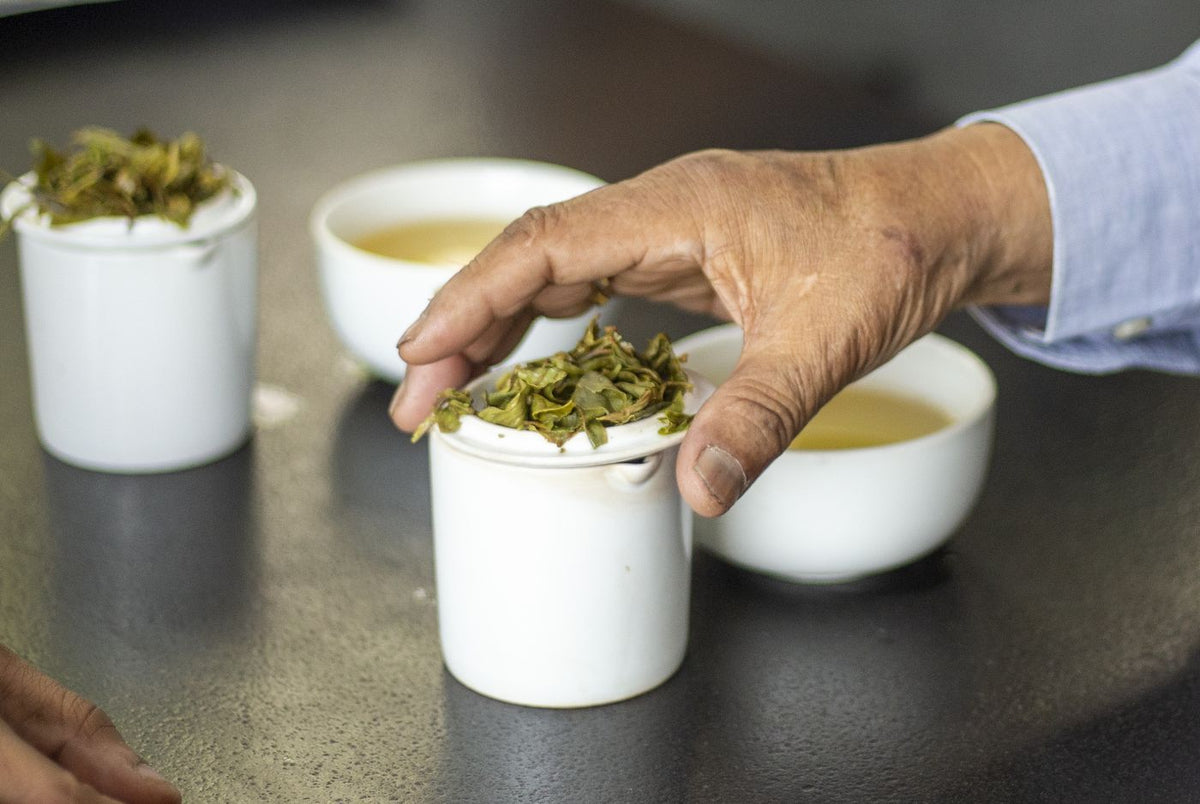
Every single-estate tea we sell is cupped by our tasting team before it is listed, at the estates during the season and at our tasting bench in Siliguri, where every sample is weighed, brewed and poured the same way. “Sample by sample, cup by cup, sip by sip, following the same tasting ritual, consistently every day at the source”: that routine is how we choose what to sell.
Where and when does Teabox taste tea?
We taste in two places: at the estates while a season is on, and at our bench in Siliguri, where samples arrive within about 12 hours of being made.Read more
Siliguri sits in the plains below Darjeeling, “parked perfectly between all the fine estates around Darjeeling, Assam and Nepal,” as one of our team wrote, which is why tasting and selection happen there. Our facility is about three hours from the Darjeeling estates, and Castleton is about an hour away.
Samples within hours
Because we are close to the gardens, we receive samples within about 12 hours of production, and each one is graded on four things: moisture, the dry leaf, the brewed leaf and the liquor. When a lot passes our eight quality checks at the garden, it reaches our facility within 24 to 48 hours of being made. Our current procurement rules ask for QC tastings of all incoming teas every day.
The first cups of a season
The first samples of a season draw a crowd. When Namring’s spring black arrived one March morning in 2019, “the tea tasting table is still surrounded by everyone wanting their first sip of the season,” and the tea went live the next evening. In July 2021 the first Assam second flush samples came in one morning from Halmari, Dikom and Doomni, and our tasters cupped them the same day.
On the road
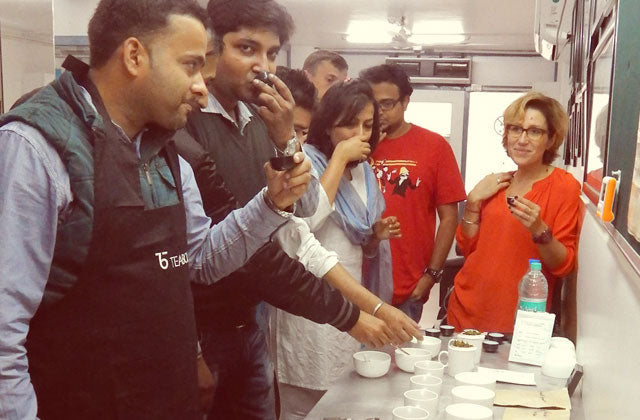
In peak season the tasting goes to the gardens. In November 2021 our founder, our procurement heads and our master tasters spent two days traveling across Darjeeling and Sikkim, sampling fresh autumn teas from Goomtee, Jungpana, Giddapahar, Bermiok, Singbulli and Oaks. Back at base, “From tasting fresh arrivals, rigorous quality checks, complaint assessments, and copious research, the tasting room feels like a giant living entity.”
Our buyers spend a lot of that time in the gardens. In his first year with us, Ravi Kothari visited the Darjeeling gardens at least three times a week in procurement season, with yearly trips to Assam and the Nilgiris.
How many cups does Teabox taste?
Thousands every season: close to 11,456 cups of Darjeeling by late October 2022, and about 100 cups a day for each master taster at the height of spring.Read more
| When | What our tasters reported | Source |
|---|---|---|
| Spring 2021 | Master tasters sampling about 100 cups a day; close to 450 samples a week; roughly 245 samples for any one tea launch | |
| Summer 2021 | Close to 50 cups of one tea, Seeyok Moonbeam Summer Muscatel, before launch | |
| Autumn 2021 | About 60 samples a day, made into 220+ cups before any autumn flush tea is shortlisted | |
| First flush 2022 | Over 1,578 cups sampled in a month | |
| Summer 2022 | 40+ samples before one Castleton muscatel was chosen for our first Private Reserve | |
| Second flush 2022 | 5,456 cups sampled | |
| Year to late October 2022 | Close to 11,456 cups of Darjeeling; about 24,678 counting chai samples | |
| First flush 2023 | Almost 80+ cups each, on average, per taster in peak season | |
| Spring 2023 | 50+ samples every day, tasted by our founder with our tea masters | |
| First flush 2024 | Over 200 cups every day at the start of the season |
At the height of spring, one tea from one division of an estate can arrive as 20 samples, and every division makes tea, which is how the counts climb so fast.
The counts are the tasters’ own estimates, and they argue over them. In October 2022 Gomden reckoned “close to 11456 cups this year”; Avishek countered that with chai samplings it was “closer to 24,678 cups”; and Gopal Upadhyay asked, “What’s the point of this count? Autumn flush is here, the number will just go up!”
Who tastes the tea at Teabox?
A small team of buyers and master tasters, working with the veteran Darjeeling tea maker and master taster Arun Kumar Gomden, with one person whose job is to make sure every cup is brewed the same way.Read more
The ritual and the people
The tasting only works if every cup is brewed the same way. In our tasting room that job belongs to Rupojit Roy: laying the setup, measuring the samples, steeping for the specified time, straining and pouring, so that “the tasters never sample a cup steeped the wrong way.”
In June 2024 we introduced the tasting team like this:
- Avishek Mondal: 14+ years in tea, and our specialist in sourcing the finest Darjeeling teas.
- Ravi Kothari: 15+ years as a taster, buyer and blender, who started as a trainee in a tea broking firm.
- Gopal Upadhyay: over 15 years in the industry, whose own favorites are the delicate Moonlight whites.
- Arun Kumar Gomden: our most senior member, with over 50 years in tea, and the fourth generation of his family in the trade.
Our buyers judge details many producers never expect. Ravi Kothari, who came to our procurement team from tea broking in 2015, recalls checking every sample’s moisture, flakes and flavor profile, and a well-known producer “shocked and offended” when his teas failed. Read his story in Meet the team: Ravi Kothari, Tea Buyer. Another producer told him the quality of his teas had improved since we started buying from him.
Blenders taste too. Shruti, who came to our Siliguri office from blending tea in Seattle, sampled between 40 and 45 teas a week, and “Gomden sir (an old tea hand)” was one of the rare few colleagues who gave her critical feedback.
The mood at the bench
When the first Nilgiri winter samples arrived in January 2023, the room woke up. Avishek: “Thank god! At last, I can get back to my ‘actual’ work.” Ravi: “The Nilgiri samples look good this year! Should we bet which one is gonna be a winner?” And Gomden: “There should be less talking, and more slurping.”
How does the team agree on a tasting note?
By tasting and arguing cup by cup until the room agrees, and only then writing the final note.Read more
Notes are argued over before they are written down. For one Castleton spring tea in June 2021, our founder, Ravi and Avishek disagreed over how strong its roasted chestnut was; the discussion lasted 55 minutes. The final note, from Arun Kumar Gomden, ended: “Subtle sensation of roasted chestnuts interlaced with hints of ripe stone-fruits shore up around the edges … Furtive notes of elderberry can be picked up in the aftertaste.”
The cups kept coming as they talked. Our founder found the chestnut “subtle”; Ravi called it “quite heavy”; Avishek sided with the founder; and the team tasted two, two, three and then four more cups between each turn before the note was locked. That tea is Castleton Spring Chinary Black.
Sometimes the verdict is quick. Tasting a 2023 muscatel, Avishek heard peach, muscat grapes and red berries, and Gomden simply said, “This is a tea not to be missed. Ravi, let’s buy this!!”
What does a season’s tasting tell us?
It tells us how the weather treated the gardens, what each tea maker did with the leaf, and whether a harvest is worth buying at all.Read more
Tasting is how we read a harvest. “The early tastings give a clear idea of the weather in the area. At a deeper level the personality of the maker comes through,” our founder wrote in March 2022. Sometimes the verdict is hard.
“After sampling over 1578 cups in the past month, I concur that the First Flush (FF) ’22 doesn’t compare to the quality of the past few years. In terms of quality & flavor, it lacks the soul of Darjeeling teas.”
A month later the tasters were surprised the other way: an early second flush, one sip, and “it’s going to be a good harvest.” A short spring, an early summer and heavy floods had looked like “the perfect recipe for a disastrous Second Flush harvest,” but by September the 5,456 cups we had sampled told “an entirely different story.”
That is the real point of cupping: honest judgments, made cup by cup. For how each season tastes, see Seasons of tea.
Keep reading
Sources
- Teabox Tea 101: Tea cupping: taste like an expert
- Teabox blog (Still Steeping), by Frank Miller: The secrets of tea-tasting (2017), Is tea-tasting only for experts? (2015); How to judge the quality of tea (2015 story, cited without a link)
- Teabox blog: What I learned at my first ever tea tasting (2016), Meet the team: Ravi Kothari, tea buyer (2015), Like water for tealeaves (2015), The muscatel master (2021), A blender of teas (2015)
- Teabox product tasting cards: Castleton Spring Chinary, Castleton Summer Muscatel, Jungpana Autumn Chinary, Halmari Summer, Mangalam Gold Summer, Kadak Chai
- Teabox Drive, tasting method and notes: Teabox internal document (Frank Miller's draft, 2016); Teabox internal document (2021); Teabox internal document (Jul 2021); Teabox internal document (Aug 2019); Teabox internal document (2014)
- Teabox Drive, training and quality: Teabox internal document, 2018; Teabox internal document, 2023 (eight quality parameters); Teabox internal document, 2015 (receiving checks); Teabox internal document, 2026
- Teabox Drive photo archive: team tasting at Goomtee and Jungpana (2021), Goomtee (2015), Shangrila, SFOKCHB product photography
- Teabox on Instagram (@teabox.tea): tasting scale, May 2020, screening checklist, May 2020, spittoon, Apr 2021, 2.5 g samples, Apr 2021, the 4S, May 2021, cups in a season, May 2021, our tasters' habits, May 2021, 55-minute note, Jun 2021, Seeyok Moonbeam, Jun 2021, first Assam samples, Jul 2021, horizontal and vertical tasting, Jul 2021, tasting ritual, Aug 2021, Mangalam oxidation tasting, Sep 2021, hill water, Oct 2021, autumn sampling trip, Nov 2021, why we slurp, Nov 2021, tasting turnout, Nov 2021, scores and three checks, Apr 2022, Castleton Private Reserve, Jun 2022, Gomden masterclass, Jul 2022, tasting notebook, Jul 2022, the tasting room, Aug 2022, cup count, Oct 2022, Rupojit Roy, Nov 2022, winter samples, Jan 2023, first flush 2023, Mar 2023, 50+ samples a day, Jun 2023, three-layer note, Jul 2023, first Namring samples, Mar 2019, facility and pack-out, Mar 2024, first flush 2024, Apr 2024, our tasting team, Jun 2024, garden to pack, Jan 2026
- Kausshal Dugarr on X (@Teapreneur): the 4S, Oct 2021, smell the leaf, Oct 2021, early tastings, Mar 2022, First Flush 2022 verdict, May 2022, early second flush, Jun 2022, coin on the scale, Aug 2022, Second Flush 2022 verdict, Sep 2022

Leave a comment
All comments are moderated before being published.
This site is protected by hCaptcha and the hCaptcha Privacy Policy and Terms of Service apply.