


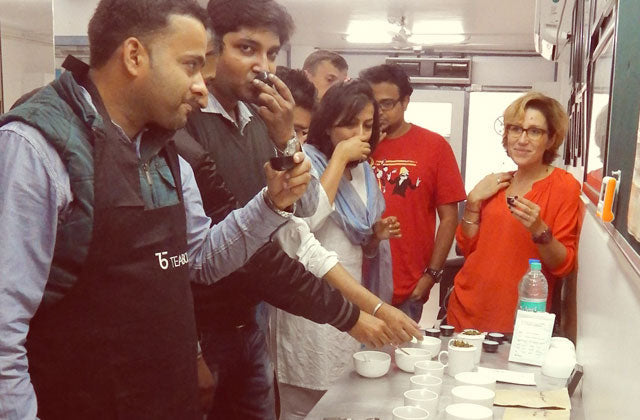
Choose three or four teas that differ in one way only, brew them side by side with the same leaf weight, water and time, and taste from lightest to strongest, writing notes as you go. Differences invisible in one cup jump out next to another. Here is how to pick a flight, run the tasting and choose your first teas.
How do you do a tea tasting at home?
Line up three or four teas that differ in one way only, brew them identically, and taste them in order from lightest to strongest.Read more
Start small: Miller suggests one or two teas at first, building to six or eight, because “It doesn’t take much to exhaust your senses.”
How do you choose a tea flight?
Pick teas that differ in just one thing, such as the season, the region, the type or the way they were made, so that whatever you taste can be traced to that one difference.Read more
Wine sommeliers taste vertically and horizontally, and our tasters borrowed both ideas. A horizontal tasting compares different gardens from the same season; a vertical tasting compares different sections or cultivars of the same garden. In September 2021 our tasters ran a vertical of another kind: one Assam, Mangalam Gold Summer Black, oxidized for four different times. Their sheets ran from “The flavors in this cup are muted” at 2 hours 30 minutes to “Let’s launch this!” at 3 hours 30 minutes. Three flights to start with:
- Three seasons: Castleton Spring Chinary Black beside Castleton Summer Muscatel Black, both from one garden, with an autumn tea such as Jungpana Autumn Chinary Black. Watch the liquor move from bright gold to amber to dark amber. Our guides to first flush vs second flush and autumn flush tea explain what changes.
- Two regions: a floral Darjeeling beside a malty summer Assam such as Halmari Summer Black, whose card reads malt, date palm and yellow raisins. This one shows contrast rather than quality: professionals judge an Assam against other Assams, since setting it against a Darjeeling is, in Miller’s words, “apples and oranges.”
- One plant, different types: a green, a white and a black tea, to taste what processing does to the same leaf. Start with Types of tea: a beginner’s guide.
One tea, three steeps
You can also taste a single tea against itself. In March 2022 our tasters steeped a fresh Badamtam Moonlight Spring White three times: the first steep gave white lilies, raw mango and muskmelon; the second vine peach, green apple and flowers; and the third, poured over ice, floral and fruity notes with green mango. Avishek thought the first cup looked “almost like white wine,” Gomden said “Champagne,” and the color debate ran on through every steep.
How do you run a tea tasting at home?
Weigh 2.5 g of each tea, brew every cup with the same volume of water for the same time, strain in the order you poured, and work through leaf, color, aroma, slurp and finish, cup by cup.Read more
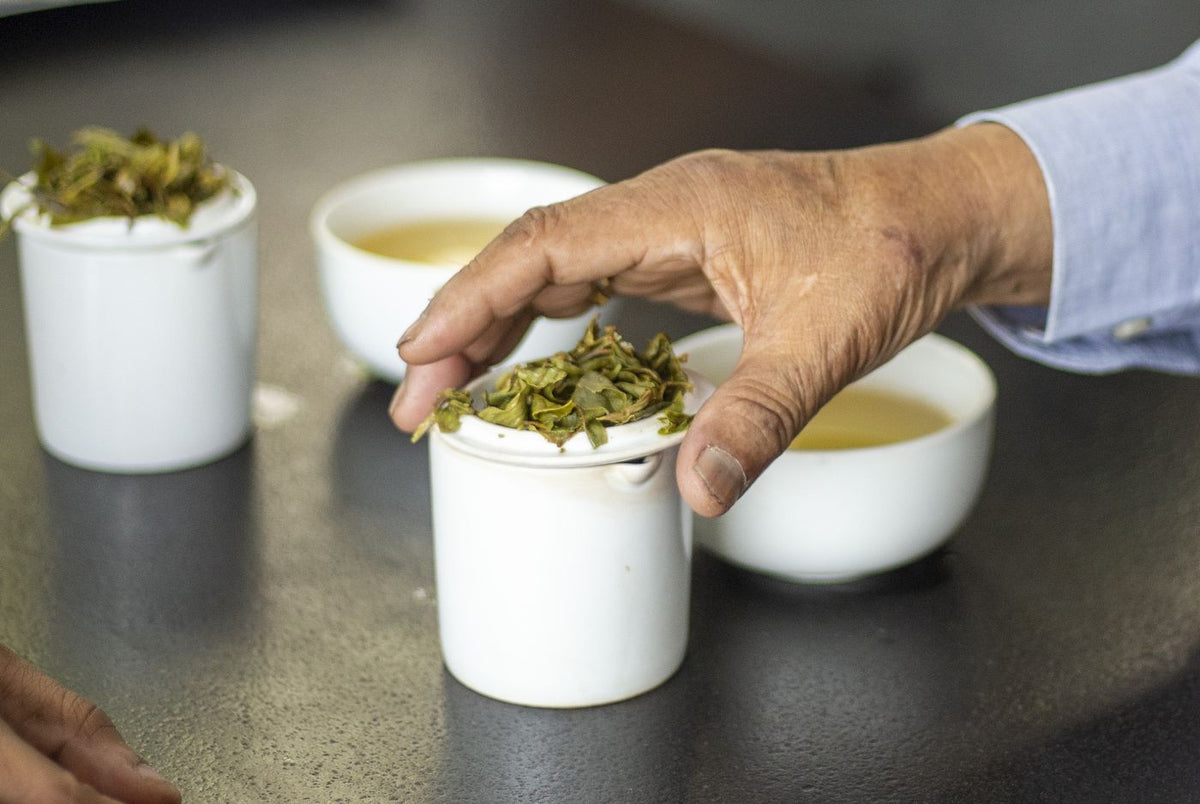
- Weigh 2.5 g of each tea onto a white card, label it, and note the dry leaf and its aroma.
- Heat fresh water. When the teas are close in type, use one temperature and one time for all of them: for the three-season Darjeeling flight, 90°C (194°F) and 4 minutes sits within the range for spring, summer and autumn teas alike. When they are not, as with Darjeeling against Assam, brew each at its own best (90–95°C for a summer Darjeeling, 95–100°C, or 203–212°F, for Assam).
- Pour 6 to 8 oz (about 180 to 240 ml) over each, the same volume every time, and start the timer as you pour the first cup.
- Strain in the order you poured, then work through leaf, color, aroma, slurp and finish, cup by cup.
- Taste plain first. Our tasters treat single-estate teas as “self drinking,” best without milk, sugar, honey or lemon. If a strong Assam is meant for milk, taste a second cup with a splash after.
- Taste again as the cups cool; some teas open up, others fall away. Pick a favorite and say why in one sentence.
For an everyday cup, our 4S will do: Smell the leaves, Steep gently, Sip and “taste every note,” Savor.
Which teas should you start with?
Start with teas whose tasting cards you can check your notes against: two seasons from one Darjeeling garden, an autumn Darjeeling and a malty Assam make an easy first flight.
Temperatures and times for every type are in How to brew loose leaf tea and How to brew Darjeeling tea.
Keep reading
Sources
- Teabox Tea 101: Tea cupping: taste like an expert
- Teabox blog (Still Steeping), by Frank Miller: The secrets of tea-tasting (2017), Is tea-tasting only for experts? (2015); How to judge the quality of tea (2015 story, cited without a link)
- Teabox blog: What I learned at my first ever tea tasting (2016), Meet the team: Ravi Kothari, tea buyer (2015), Like water for tealeaves (2015), The muscatel master (2021), A blender of teas (2015)
- Teabox product tasting cards: Castleton Spring Chinary, Castleton Summer Muscatel, Jungpana Autumn Chinary, Halmari Summer, Mangalam Gold Summer, Kadak Chai
- Teabox Drive, tasting method and notes: Teabox internal document (Frank Miller's draft, 2016); Teabox internal document (2021); Teabox internal document (Jul 2021); Teabox internal document (Aug 2019); Teabox internal document (2014)
- Teabox Drive, training and quality: Teabox internal document, 2018; Teabox internal document, 2023 (eight quality parameters); Teabox internal document, 2015 (receiving checks); Teabox internal document, 2026
- Teabox Drive photo archive: team tasting at Goomtee and Jungpana (2021), Goomtee (2015), Shangrila, SFOKCHB product photography
- Teabox on Instagram (@teabox.tea): tasting scale, May 2020, screening checklist, May 2020, spittoon, Apr 2021, 2.5 g samples, Apr 2021, the 4S, May 2021, cups in a season, May 2021, our tasters' habits, May 2021, 55-minute note, Jun 2021, Seeyok Moonbeam, Jun 2021, first Assam samples, Jul 2021, horizontal and vertical tasting, Jul 2021, tasting ritual, Aug 2021, Mangalam oxidation tasting, Sep 2021, hill water, Oct 2021, autumn sampling trip, Nov 2021, why we slurp, Nov 2021, tasting turnout, Nov 2021, scores and three checks, Apr 2022, Castleton Private Reserve, Jun 2022, Gomden masterclass, Jul 2022, tasting notebook, Jul 2022, the tasting room, Aug 2022, cup count, Oct 2022, Rupojit Roy, Nov 2022, winter samples, Jan 2023, first flush 2023, Mar 2023, 50+ samples a day, Jun 2023, three-layer note, Jul 2023, first Namring samples, Mar 2019, facility and pack-out, Mar 2024, first flush 2024, Apr 2024, our tasting team, Jun 2024, garden to pack, Jan 2026
- Kausshal Dugarr on X (@Teapreneur): the 4S, Oct 2021, smell the leaf, Oct 2021, early tastings, Mar 2022, First Flush 2022 verdict, May 2022, early second flush, Jun 2022, coin on the scale, Aug 2022, Second Flush 2022 verdict, Sep 2022

Leave a comment
All comments are moderated before being published.
This site is protected by hCaptcha and the hCaptcha Privacy Policy and Terms of Service apply.