


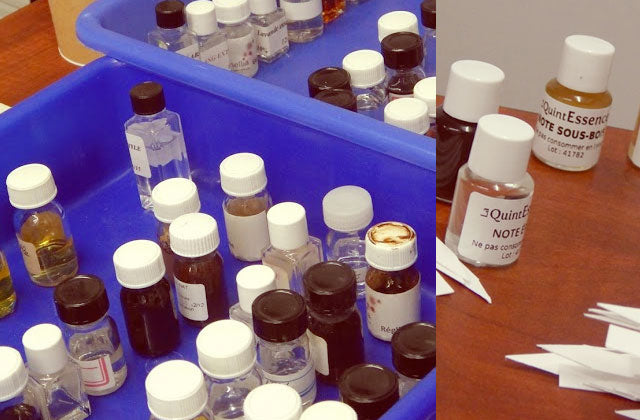
A shared vocabulary is what turns a private impression into something another taster can check. “To talk about tea we need a common language so we can share and communicate each other’s experiences better,” the perfumer and tea expert Carine Baudry told our team in Siliguri. This page gathers the words our tasters use, shows real Teabox tasting cards, and tells how one famous word, muscatel, came into the trade.
What words do tea tasters use?
Tasters describe the body (light, medium or full), astringency, briskness, texture, complexity, the length of the finish and the character notes (floral, fruity, malty, muscatel, nutty, woody), and they describe faults just as precisely.Read more
- Body: how heavy the tea feels in the mouth: light, medium or full.
- Astringency: the dry, puckering feel on gums and tongue. Some is good: it gives tea its crispness. It is not the same as bitterness.
- Brisk: lively and fresh, the opposite of flat.
- Length: how long the flavor lingers after you swallow: short, medium or long.
- Notes: the aromas you can name, from muscatel (a grape-like note of some second flush Darjeeling) to malt in Assam.
- Self-drinker: Frank Miller’s term for “a pure unblended tea with superior, stand-alone qualities” that “needs no fortification or remediation.” Our tasters call such teas “self drinking.”
Good words and warning words
Miller kept a working list for each stage, with the faults set against the praise. A few from each line:
- Aroma and taste: flowery, fruity, sweet, malty, tart, vegetal, spicy, complex and balanced, against simple, bland, sour, dull, insipid, overripe, moldy or tainted.
- Liquor color: clear, bright, coppery, gold or amber, against cloudy, murky, colorless or showing sediment.
- Mouthfeel: delicate, soft, round, with light or medium astringency, against bitter, shallow or lacking astringency.
- Dry leaf: well made, well sorted, tightly rolled, with no stem, against irregular, poorly sorted, too much stem or poorly made.
Beware vague praise: “mild,” “smooth” and “light,” Frank Miller wrote, “are not words of quality.” He also notes how closely a tea conforms to the standard for its type, garden and region, and its grade (OP, FOP, BOP, CTC) if it has one. For the full vocabulary, from “bakey” to “wiry,” see our Tea glossary: A to Z of tea terms.
What is the difference between bitterness and astringency?
Astringency is the dry, puckering feel picked up by the soft tissues of the mouth, and it gives a tea its body; bitterness is a taste, picked up by the tongue.Read more
“Don’t confuse bitterness with astringency,” Miller warns: they are “two of the least understood qualities in brewed tea and are very different.” With few exceptions a tea should show some astringency, especially a black tea. Bitterness is the tongue’s old warning, “do not eat this item; it may be poisonous!”, though a little bite can suit tea as it suits beer or coffee.
Our buyers draw the line in the same place. They want only minimal astringency in the liquor, and for them “bitterness is a deal breaker.”
Even trained tasters find the line hard to hold. At our Siliguri workshop the team “worried over astringency – how much is too much and is it really just another kind of bitter?” For how water temperature and time change a home cup, see How to brew loose leaf tea.
How is a tea tasting note written?
A good tasting note travels through the cup in the order you taste it, from the first aroma to the finish, and our product cards record the dry leaf, the infused leaf and the liquor separately.Read more
Our tasters often build a note in three layers, the way perfumers do. Of one 2023 muscatel, Avishek Mondal said: “It has the top note of a peach, heart note of muscat grapes and base note of red berries.” Arun Kumar Gomden, the veteran Darjeeling tea maker and master taster who named the muscatel teas at Castleton in the mid-1980s and later worked with our tasting team, agreed, and we bought the tea.
Our house tasting card has fixed fields: a one-line summary, a description, aroma, taste, leaf appearance, infused leaf, liquor color and foods it complements. For an Oaks summer chinary in 2019 the card suggested semi-hard cheeses, fresh fruit and pancakes.
A real tasting card
Our product pages carry a tasting card built on the same three stages. Here is the card for one lot of Castleton Summer Muscatel Black, from the garden where the muscatel name began:
| Stage | Appearance | Aroma |
|---|---|---|
| Dry leaf | Short, blackish-brown leaves with some luminous, mahogany buds | Fresh nuts, biscotti, a hint of caramel |
| Infused leaf | A mix of dark-brown and light coppery leaves | Musky, wet vegetation, stewed plum |
| Liquor | Light amber | Muscat grapes, peach, cedar, light nutty undertones |
And the taste: “a medium-bodied, lively cup which opens on a delicious register of Muscat grapes intertwined with an evocative tone of peach,” with cedar and hazelnut in the middle and a finish of red berries. Good tea tasting notes travel through the cup from start to finish, in the order you taste them.
A card for a strong chai tea
The same fields work for a chai tea made for milk. Our 2021 card for Teabox Kadak Chai reads:
- Dry leaf: blackish-brown nuggets with specks of floating fiber, with an earthy, hay and biscotti aroma and mild nutty and cocoa hints.
- Infused leaf: “Bright coppery,” a sign of an even, well-made tea.
- Liquor: reddish brown, with malt, dates, wood and hints of dried drupes.
- Taste: “A strong, brisk cup which brims with robust notes of malt.”
How did the word “muscatel” come into the tea trade?
It is credited to a tea maker: Arun Kumar Gomden says he chose the word for a record-breaking Castleton second flush in the mid-1980s, and since then, in his words, “high-flavored teas of the second flush have been called muscatels.”Read more
Gomden is the fourth generation of his family in tea. His great-grandfather came to Darjeeling from Nepal in the late 1870s and rose to Tea Maker Sardar, and Gomden himself joined Singbulli in 1968 as a factory assistant manager before moving to Castleton.
At Castleton he made a second flush batch of orthodox chinary with “remarkable flavors.” At auction it sold at Rs. 583, a record, and a week later at Rs. 1,460. Gomden recalls that it was later served to Hirohito, the former Emperor of Japan.
“A special tea deserved a special name,” he says. “I perused the dictionary and settled on the word muscatel, which meant ‘grape’ or ‘fruity’; it did justice to the unique flavor and aroma.” Until then, he explains, teas were simply called chinary or clonal. Read the full interview in The Muscatel Master, and taste the garden in Castleton Summer Muscatel Black.
The making is as precise as the naming. “I have always believed taste is in the tea bushes,” Gomden says, “and to make it blossom is in the hands of a tea maker.”
How do you learn the language of tasting?
By tasting and smelling a lot, side by side, and agreeing with other tasters on what each word means.Read more
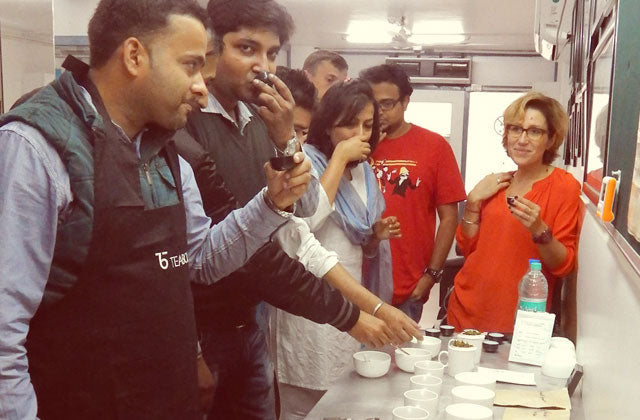
Words come with practice, even for professionals. Around the start of 2016, a Paris-based perfumer and tea expert, Carine Baudry, ran a two-day sensory workshop for our team in Siliguri: “To talk about tea we need a common language,” she told them. Read the account in What I Learned at My First Ever Tea Tasting.
Her first exercise set the base line. The buyers, blenders and marketers sipped five solutions in clear tumblers, sweet, salty, sour, bitter and umami, until they agreed on each. Over the two days they smelled more than 40 perfumes from small vials, tasted more than 30 teas from Darjeeling and Assam to Long Jing and Sencha, and brewed teas in three different waters to taste the effect of minerals.
Baudry’s favorite example of why words matter: one participant described a Darjeeling summer black as smelling like her grandmother’s home. She meant wild roses, but no one else could share the impression until it had the right name.
There is no shortcut to a trained nose. Arun Kumar Gomden, the veteran Darjeeling tea maker and master taster who has worked with our tasting team, learned from his father and grandfather, both tea makers, on tasting days that “would numb and coat the tongue by the end of the day, but they would remind me there was no shortcut. To know tea better, one needs to taste it.” His own rule for the craft: “the eyes of a hawk, nose of a dog, and ears of a cat.”
The skill underneath is what the chef James Beard called “taste-recall”: once you have tasted sour cherries, black pepper or wildflower honey, you can recognize them when you meet them again. Miller warns that becoming very good takes “thousands” of teas, but “you don’t have to be an expert to do it passably well.”
Keep reading
Sources
- Teabox Tea 101: Tea cupping: taste like an expert
- Teabox blog (Still Steeping), by Frank Miller: The secrets of tea-tasting (2017), Is tea-tasting only for experts? (2015); How to judge the quality of tea (2015 story, cited without a link)
- Teabox blog: What I learned at my first ever tea tasting (2016), Meet the team: Ravi Kothari, tea buyer (2015), Like water for tealeaves (2015), The muscatel master (2021), A blender of teas (2015)
- Teabox product tasting cards: Castleton Spring Chinary, Castleton Summer Muscatel, Jungpana Autumn Chinary, Halmari Summer, Mangalam Gold Summer, Kadak Chai
- Teabox Drive, tasting method and notes: Teabox internal document (Frank Miller's draft, 2016); Teabox internal document (2021); Teabox internal document (Jul 2021); Teabox internal document (Aug 2019); Teabox internal document (2014)
- Teabox Drive, training and quality: Teabox internal document, 2018; Teabox internal document, 2023 (eight quality parameters); Teabox internal document, 2015 (receiving checks); Teabox internal document, 2026
- Teabox Drive photo archive: team tasting at Goomtee and Jungpana (2021), Goomtee (2015), Shangrila, SFOKCHB product photography
- Teabox on Instagram (@teabox.tea): tasting scale, May 2020, screening checklist, May 2020, spittoon, Apr 2021, 2.5 g samples, Apr 2021, the 4S, May 2021, cups in a season, May 2021, our tasters' habits, May 2021, 55-minute note, Jun 2021, Seeyok Moonbeam, Jun 2021, first Assam samples, Jul 2021, horizontal and vertical tasting, Jul 2021, tasting ritual, Aug 2021, Mangalam oxidation tasting, Sep 2021, hill water, Oct 2021, autumn sampling trip, Nov 2021, why we slurp, Nov 2021, tasting turnout, Nov 2021, scores and three checks, Apr 2022, Castleton Private Reserve, Jun 2022, Gomden masterclass, Jul 2022, tasting notebook, Jul 2022, the tasting room, Aug 2022, cup count, Oct 2022, Rupojit Roy, Nov 2022, winter samples, Jan 2023, first flush 2023, Mar 2023, 50+ samples a day, Jun 2023, three-layer note, Jul 2023, first Namring samples, Mar 2019, facility and pack-out, Mar 2024, first flush 2024, Apr 2024, our tasting team, Jun 2024, garden to pack, Jan 2026
- Kausshal Dugarr on X (@Teapreneur): the 4S, Oct 2021, smell the leaf, Oct 2021, early tastings, Mar 2022, First Flush 2022 verdict, May 2022, early second flush, Jun 2022, coin on the scale, Aug 2022, Second Flush 2022 verdict, Sep 2022

Leave a comment
All comments are moderated before being published.
This site is protected by hCaptcha and the hCaptcha Privacy Policy and Terms of Service apply.