


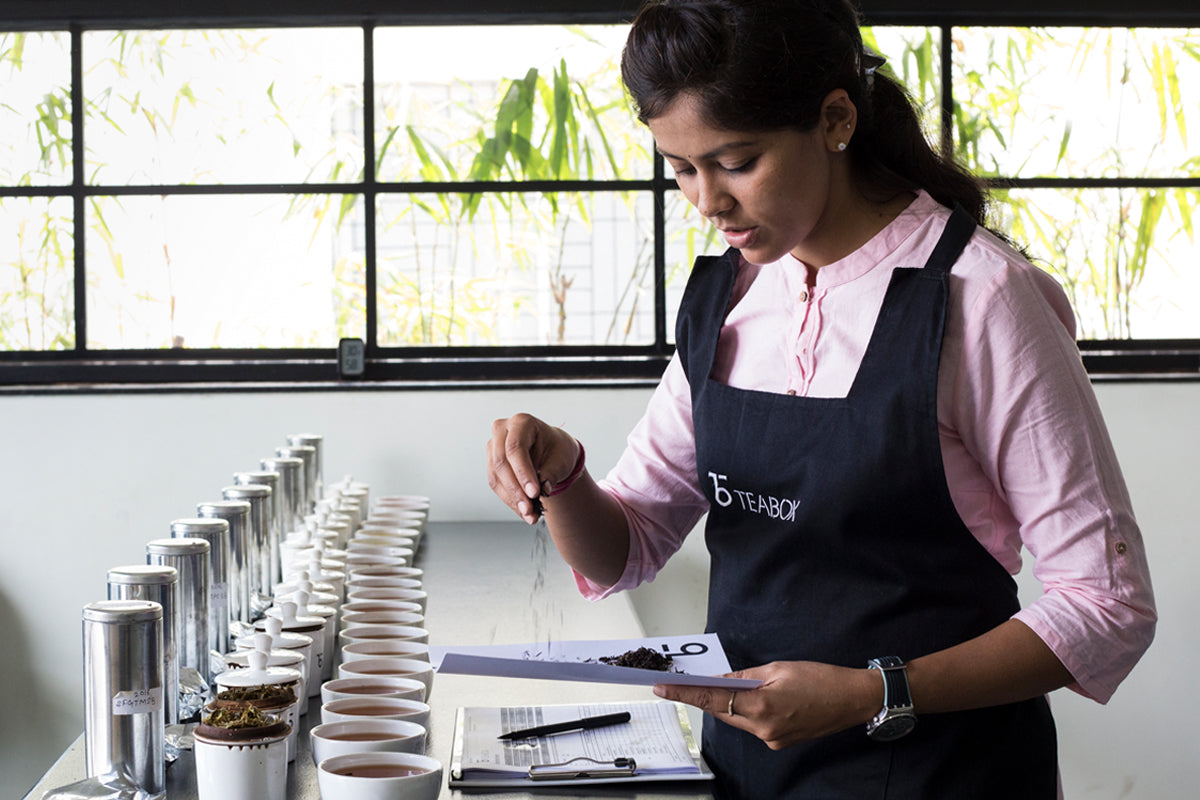
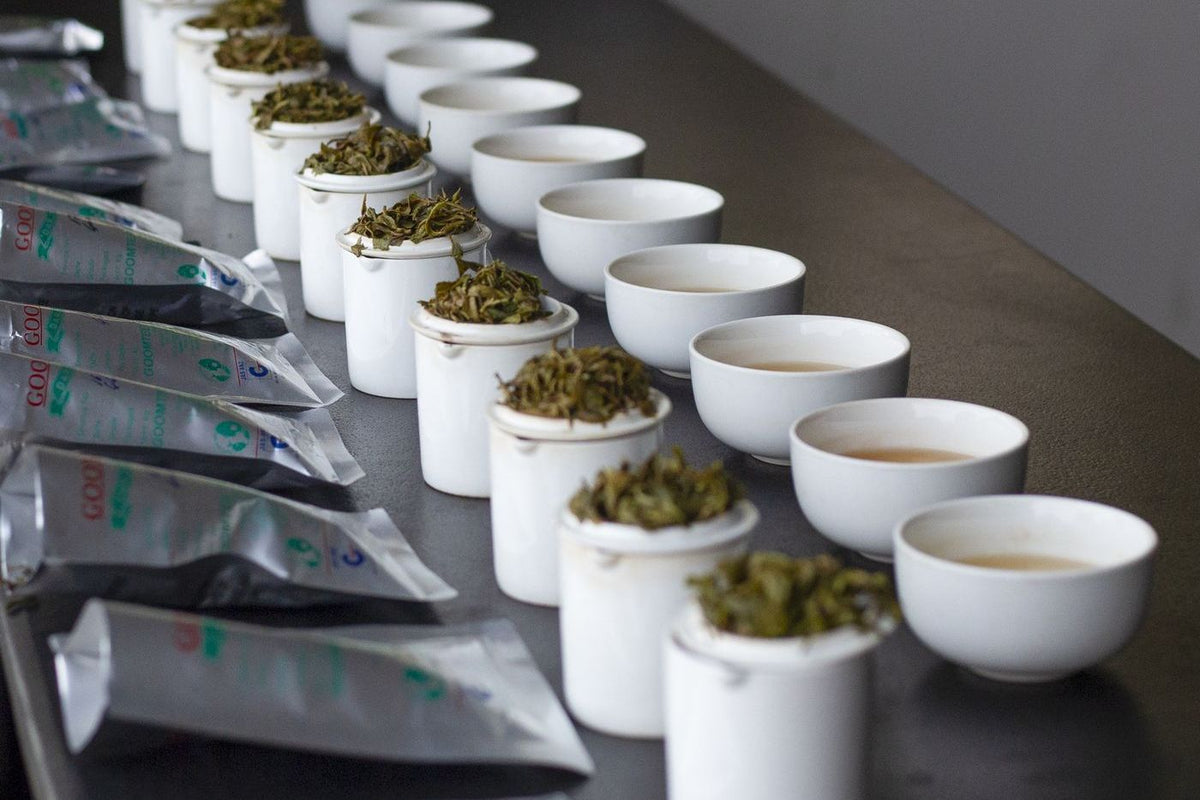
A cupping always runs in the same order: the dry leaf, then the infused leaf, then the liquor, each judged by eye and by nose before the tea is slurped. Here is our tasters’ sequence, adapted for home, followed by the professional bench method, what to look for at each stage, and how a cup is scored.
How do you cup tea, step by step?
Weigh the same amount of each tea, look at and smell the dry leaf, brew every cup with the same water and time, strain, then judge the infused leaf, the liquor’s color and aroma, and finally its taste by slurping.Read more
- Know what you are tasting. Note the type (black, green, white, oolong or a blend), the estate, the season and the year. As Frank Miller put it, “For an experienced tea-taster, a tea is seldom a blind date.” In his own notes, each sample bag is labeled with the tea type, grade, garden, number, commercial source, his tasting code and the date.
- Lay out the dry leaf. Spread a little on your white card; Miller uses about 5 g on a clean white plate. Note its size, shape and color, how evenly it is sorted, and whether you see buds, silver or golden tips, stems, flakes or dust. These are clues to the tea grade and to how carefully the tea was plucked and made. Spongy leaf is damp; powdery leaf is too dry. Our own tasting notes add that dry leaf should feel crunchy between your fingers.
- Smell the dry leaf. Breathe warm air onto it and sniff. Is it floral, nutty, malty, fruity, grassy, toasty? As our founder wrote, the aroma of the dry and infused leaf tells you “a great deal regarding the freshness, depth of flavor, & quality of the tea leaves.”
- Weigh and brew. Use 2.5 g of leaf per cup, water at the right temperature for the type, and the same time for every cup. Pour along the row in a fixed order.
- Strain. On time, pour off every cup in the same order, so none keeps brewing, and turn out the infused leaf.
- Judge the infused leaf. While it is still hot, lift it to your nose and sniff several times. Frank Miller calls this aroma a foretaste of what is in the cup, and sometimes it reveals what the cup does not. Then look: an even, bright color is a sign of careful making; a dull or patchy mix of colors is a warning. The old Tea 101 guide adds that “A vegetal aroma is considered a mark of a good, fresh tea” at this stage.
- Look at the liquor. Hold the bowl to the light. Judge the color and whether it is bright and clear or dull and cloudy. Black tea liquor is never truly black: it runs from reddish amber to deep mahogany. Green tea is seldom deep green either, but “a light, greenish amber or bluish green.”
- Smell the liquor. Bring the bowl close and take in the first notes, which the old Tea 101 guide calls the “attack.” A fresh tea smells clean and definite, with no damp or musty note.
- Slurp. Let the liquor cool slightly, then suck a spoonful in hard and noisily, with plenty of air, so it sprays across your palate. Roll it around. Note sweet, sour, bitter and savory, then breathe out through your nose to catch the flavor notes. Practice with tepid water first, so you learn to slurp without choking, and, as Miller advises, “be sure you feel the epiglottis (flap) close over the windpipe.” Our tasters coach each other to “Roll it inside your tongue” and “Let it dance on your palate.” “The louder the slurp, the better.”
- Judge the finish. Spit or swallow, then wait. How long does the flavor last? Is the aftertaste sweet and clean, or harsh? Write it down before the next cup.
How do professional tasters set up the bench?
On a professional bench every cup gets the same leaf weight, the same water, the same temperature and the same time, so that the only thing that changes from cup to cup is the tea.Read more
The method we have published
The one bench method published on our blog is Frank Miller’s. He puts 2.5 g of dry leaf (0.10 oz) into the standard 150 ml brewing cup, fills it with freshly boiled water, covers it and steeps for 5 minutes.
When the time is up, he decants the tea into a white cup through a stainless steel strainer and puts the lid back on the brewing cup to keep the leaves warm. He brews every sample at the same temperature, even delicate whites and greens that many people steep cooler, because “That, to me, is a more scientific way of approaching it.” He adds, fairly: “No doubt, others will disagree.”
Professionals vary the order
Not every taster starts with the dry leaf. Miller sniffs the warm infused leaf first, while the liquor cools, then slurps, and only afterward goes back along the row to record the liquor color, infusion color, leaf shape and size. He tries “not to cover more than ten to twelve teas at once,” a small share of what a commercial taster gets through.
Keeping track of the cups
As he works, Miller moves the cups toward or away from himself to remember which he liked, which were average and which he did not favor, and he numbers every tea so notes and samples stay matched. His notes are practical: “Def. buy this one!” or “Really good for an iced tea blend.”
Setting up the table and the taster
Miller sets up his bench at a working-height counter with a water-resistant surface, in ample natural light, north-facing if he can.
The taster needs as much care as the table. Shruti, who blended teas for us in Siliguri, kept strict rules: on tasting days she left home by half past six without even a morning cup, because it affects the palate, and she wore no fragrance. “They affect the flavors when I am tasting or blending.”
On our own bench the setup belongs to one person, so that no cup is brewed differently from its neighbors; see Inside the Teabox tasting room.
What to look for in the leaf, liquor, aroma and taste
Look for well-made, evenly sorted dry leaf, fresh aroma at every stage, bright evenly colored infused leaf, and a clear, bright liquor that tastes balanced, with astringency but no harsh bitterness and a pleasant aftertaste.Read more
When our tasters screen a sample, they check the dry leaf for bloom and aroma, the wet leaf for color and aroma, and the liquor for color, aroma, astringency, strength, flavor, bitterness, body and aftertaste. In a fresh first flush that means lightly rolled emerald-green leaf with silver pubescence, then tender olive-green infused leaf with spring sap aromas, and a floral, faintly fruity cup “with no bitterness at all.”
| Stage | Look for | Warning signs |
|---|---|---|
| Dry leaf | Well twisted, true to type, evenly sized, with young buds and some bloom; fresh, distinct aroma | Dust, flakes, stalk, uneven sizes; spongy (damp) or powdery leaf; flat or stale smell |
| Infused leaf | Bright, even color; a fresh, sweet fragrance | Dull, dark or patchy color; a dull, flat or smoky smell |
| Liquor: look | Clear, bright, reflective; a true color for the type | Cloudy, muddy or dull |
| Liquor: taste | Balanced, with lively astringency, clear notes, good body and a lingering, pleasant finish | Harsh bitterness, a flat or thin cup, a short or drying finish |
Our eight buying checks
Before a tea joins our range, it has to pass eight quality checks, which our training deck and our own posts describe like this:
- Appearance: a stylish leaf, well twisted and long, with ample young buds, or a clean, grainy texture for CTC.
- Sizing: well sorted and true to type, with a good bloom on the leaf.
- Infused leaf: brightness in the wet leaf, which signals a refreshing, sweet fragrance.
- Liquor color: it must suit the time of the season, from pale spring gold to dark autumn amber.
- Bitterness: only minimal astringency in the liquor, and no harsh bitterness at all.
- Aftertaste: a pleasant finish, the kind that makes you reach for the same cup again.
- Moisture: below 5%, with about 3% as the ideal our deck gives.
- Density: denser leaf goes further, because you get more from a single teaspoon of tea.
Our own buying checklist adds two hard limits: moisture must be below 5%, and “bitterness is a deal breaker.”
Tasting continues after a lot is bought. When it reaches our facility, each sack and a composite sample are checked for moisture and for broken leaf, flakes and dust, and tasted in a triangle test, where a taster must pick out the one cup of three that differs.


How do tea tasters score a cup?
Most tasters give each cup a number out of 10 as well as words; on the scales we use, a 9 is outstanding, and our quality plan has asked for more than 7 before a lot passes.Read more
Our 2014 cupping form, adapted from the form coffee cuppers use, sets the scale: 6 is Good, 7 Very Good, 8 Excellent and 9 Outstanding. Our 2015 quality plan required a sensory score above 7 for a lot to pass.
A real scoring round
Scores rarely match exactly. For one first flush oolong from Singbulli in April 2022, Avishek Mondal said, “This cup scores 9 overall”; Jonaki gave it 9.5; and Arun Kumar Gomden’s ranking “varied from 8.95 to 9.25.” Because it scored 9 consistently with our master tasters, procurement managers and quality team, we launched it as an exclusive batch.
Each taster also has a tell at the bench. When Gomden likes a cup, his signature move is a slight turn of it to the right; Avishek samples the same cup again and again to make sure; Ravi Kothari simply pushes his choice ahead.
Frank Miller’s scale
Miller kept his own 1 to 10 scale. On it, “a score of 5 means ‘This is tea, not coffee!’ A score of 6 says ‘OK, good, but not great.’” He would buy a chest of a tea scored 9, and save a 10 for his “Noble Teas Prize.”
In one tasting he gave a Gopaldhara autumn clonal black from Darjeeling 7.5 to 8.0, for malty, peppery dry leaf and notes of green apple, roses and muscatel. A Halmari Assam got 6.5 to 7.0: “a bit plain, but well made. With milk, it’s a viable breakfast tea.” Taste the garden for yourself in Halmari Summer Black.
Keep reading
Sources
- Teabox Tea 101: Tea cupping: taste like an expert
- Teabox blog (Still Steeping), by Frank Miller: The secrets of tea-tasting (2017), Is tea-tasting only for experts? (2015); How to judge the quality of tea (2015 story, cited without a link)
- Teabox blog: What I learned at my first ever tea tasting (2016), Meet the team: Ravi Kothari, tea buyer (2015), Like water for tealeaves (2015), The muscatel master (2021), A blender of teas (2015)
- Teabox product tasting cards: Castleton Spring Chinary, Castleton Summer Muscatel, Jungpana Autumn Chinary, Halmari Summer, Mangalam Gold Summer, Kadak Chai
- Teabox Drive, tasting method and notes: Teabox internal document (Frank Miller's draft, 2016); Teabox internal document (2021); Teabox internal document (Jul 2021); Teabox internal document (Aug 2019); Teabox internal document (2014)
- Teabox Drive, training and quality: Teabox internal document, 2018; Teabox internal document, 2023 (eight quality parameters); Teabox internal document, 2015 (receiving checks); Teabox internal document, 2026
- Teabox Drive photo archive: team tasting at Goomtee and Jungpana (2021), Goomtee (2015), Shangrila, SFOKCHB product photography
- Teabox on Instagram (@teabox.tea): tasting scale, May 2020, screening checklist, May 2020, spittoon, Apr 2021, 2.5 g samples, Apr 2021, the 4S, May 2021, cups in a season, May 2021, our tasters' habits, May 2021, 55-minute note, Jun 2021, Seeyok Moonbeam, Jun 2021, first Assam samples, Jul 2021, horizontal and vertical tasting, Jul 2021, tasting ritual, Aug 2021, Mangalam oxidation tasting, Sep 2021, hill water, Oct 2021, autumn sampling trip, Nov 2021, why we slurp, Nov 2021, tasting turnout, Nov 2021, scores and three checks, Apr 2022, Castleton Private Reserve, Jun 2022, Gomden masterclass, Jul 2022, tasting notebook, Jul 2022, the tasting room, Aug 2022, cup count, Oct 2022, Rupojit Roy, Nov 2022, winter samples, Jan 2023, first flush 2023, Mar 2023, 50+ samples a day, Jun 2023, three-layer note, Jul 2023, first Namring samples, Mar 2019, facility and pack-out, Mar 2024, first flush 2024, Apr 2024, our tasting team, Jun 2024, garden to pack, Jan 2026
- Kausshal Dugarr on X (@Teapreneur): the 4S, Oct 2021, smell the leaf, Oct 2021, early tastings, Mar 2022, First Flush 2022 verdict, May 2022, early second flush, Jun 2022, coin on the scale, Aug 2022, Second Flush 2022 verdict, Sep 2022

Leave a comment
All comments are moderated before being published.
This site is protected by hCaptcha and the hCaptcha Privacy Policy and Terms of Service apply.