



Few plants are so closely woven into Indian daily life as tulsi: it is watered, offered, prayed to and brewed, often in the same morning. This page follows the plant from the courtyard and the temple to Ayurveda and the chai pot. We describe this tradition as a tradition: it shapes how tulsi is used in India, and it is not evidence that a cup will do anything in particular.
Why is tulsi sacred in Hindu homes?
Tulsi is held sacred to Vishnu and to Krishna, one of his forms, so many Hindu families keep a tulsi plant at home, tend it every day and use its leaves in worship.Read more
The plant in the courtyard
In many Hindu homes, a tulsi plant grows in a raised planter in the courtyard, on a balcony or by the front door. Many households water it each morning and light a lamp beside it at dusk.
Its leaves are part of the offerings at temples and home shrines. Each year, in the month of Kartik (around October and November), many families celebrate Tulsi Vivah, a ceremonial wedding of the tulsi plant to Vishnu, which marks the start of the Hindu wedding season.
Tulsi leaves at Majuli
The leaf also carries blessings. Majuli, the river island in Assam, is home to centuries-old Vaishnavite monasteries called satras, and is also said to be the fabled love nest of Radha and Krishna. Assam’s Vaishnavite saint Shankaradeva and his disciple Madhabdeva founded 22 satras there, and pilgrims still cross to them on the ferry from Jorhat.
On a visit in 2016, one of our writers went to the Dakshinpat, Auniati and Guagacha satras, where images of Krishna lined the temple walls. In the prayer halls, called namghars, the priests blessed our writer “with champa flowers and tulsi leaves.” The full account is in Assam Diaries: A Day at Majuli.
What is tulsi’s place in Ayurveda?
Ayurveda counts tulsi among the herbs it prizes most: it appears in classical texts under the name surasa, and it is described as pungent and warming.Read more
Ayurveda, which literally means “knowledge of life,” describes the body in terms of three energies, or doshas: Vata (air and space), Pitta (fire and water) and Kapha (earth and water). Our 2020 story on Ayurveda and yoga calls it “this 5,000-year-old wisdom,” and notes that yoga, its companion practice, was first recorded by Patanjali sometime between 500 BCE and 400 CE.
Its wisdom was “passed down by oral traditions through generations,” and much of it lives on in the kitchen, where everyday herbs and spices double as simple brews. That year, as many people in India fell back on what our blog called “traditional means of remedies,” we introduced the subject in The Art of Wellbeing.
Warming herbs and the seasons
Ayurveda also classifies herbs by taste and by whether they are warming or cooling, and tulsi sits with the warming herbs. That is the thinking behind many seasonal cups: our 2025 winter post described the Ayurvedic view that the cold season raises Vata and Kapha, and that the answer is to “warm up, nourish deeper, and choose grounding rituals,” with herbs such as tulsi, ginger, cinnamon, ashwagandha and licorice.
We describe this tradition as a tradition. It shapes how tulsi is used in India; it is not evidence that a cup will do anything in particular, a point we return to in what the research says. For how the other chai spices fit the same thinking, see Chai spices and Ayurveda.
How did tulsi reach the chai pot?
Through India’s old habit of boiling herbs and spices into a drink long before tea was grown here; tulsi came into the chai pot alongside ginger, black pepper and cardamom.Read more
Our history of chai retells a legend of a spiced drink used in Ayurveda and “now popularly known as ‘kadha.’” As the story points out, it “contained no Camellia sinensis.” Herb brews of this kind, tulsi among them, are older than tea in India. See The Journey of Our Beloved Chai.
When black tea arrived, the same herbs and spices went into the pan with it. As our 2023 chai story put it, black pepper, ginger, tulsi and green cardamom “have a special mention in our ancient scriptures and are widely used in traditional Indian households.” The story tours India’s regional chais: The Authentic Indian Chai Experience.
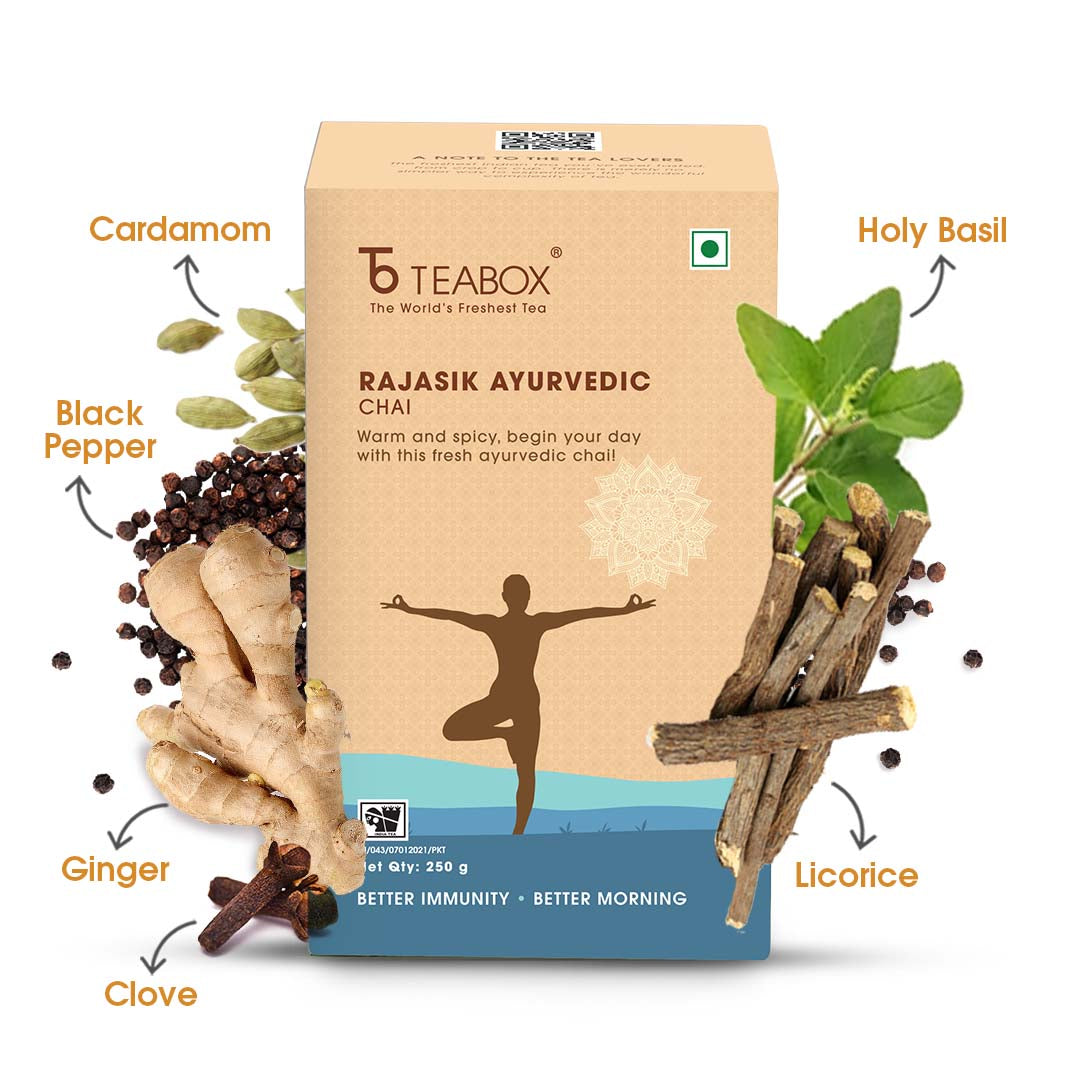
Our own range follows the same line, from the Masala Indian Chai of 2014, black tea with seven spices and tulsi, to today’s Rajasik Ayurvedic Chai. India’s other chais are gathered in Types of chai in India.
Keep reading
Sources
- Teabox blog: How to Make Lemongrass Tea (2015), The Science Behind My Ginger Chai (2015), Assam Diaries: A Day at Majuli (2016), Nostalgia in a Spray (2016), Assam Diaries: Margherita, the Singphos and Coin Tea (2016), The Art of Wellbeing (2020), The Journey of Our Beloved Chai (2020), The Authentic Indian Chai Experience (2023)
- Teabox blog (Still Steeping): “Natural” teas: The rewards, the risks and the watch-outs!, 2016; Ancient Remedies in Modern Times: Ayurveda and Yoga, 2020
- Teabox Tea 101: Chai, the Indian way of drinking tea, Flavored blends; caffeine figures from the Tea 101 caffeine posts
- Teabox product records (descriptions, ingredients, tasting notes, brewing and FAQ fields), October 2026: Rajasik Ayurvedic Chai, Turmeric Ginger Tulsi Green (Teabags), Abhay Ras Chai, Soma Ayurvedic Chai, Ayurvedic Chai Trial Pack
- Teabox Drive: Teabox internal document (2014 SKU records and 2021 tea descriptions); Teabox internal document, 2016; Teabox internal document (blending unit records, 2018 to 2019); Teabox internal document, 2026; Teabox internal document, 2026; photos Teabox internal document, Teabox internal document, Teabox internal document
- Teabox on Instagram (@teabox.tea): Basil Twirl, Apr 2016, Be CALM, Jan 2019, Gaja Indian Heritage box, Oct 2021, Rajasik, Nov 2024, winter Ayurvedic chais, Dec 2025
- Standard botanical and cultural references for tulsi’s species, types and customs (flagged for review in the notes)

Leave a comment
All comments are moderated before being published.
This site is protected by hCaptcha and the hCaptcha Privacy Policy and Terms of Service apply.