


Tulsi tea tastes peppery and clove-like, with a fresh, green, slightly minty edge and a gentle warmth that lingers. Green-leaved Rama tulsi is the mildest; purple-leaved Krishna tulsi is the most peppery; wild Vana tulsi is the most aromatic and lemony. Drying, steeping time and what you brew tulsi with change the cup again.
What does tulsi tea taste like?
Tulsi tea tastes peppery and clove-like, with a fresh, green, slightly minty edge, and the aroma is its clearest part.Read more
When a perfumer created an Indian scent with notes of “bergamot with Indian basil (tulsi),” she reached for it to bring back “crisp green notes” after a watery one: “That’s how the tulsi and mint came in.” Her story is in Nostalgia in a Spray.
When we released a tulsi blend in 2016, Basil Twirl, with holy basil, cornflower and orange and yellow marigold, we called it “a poignant melody of fresh and floral flavors.”
Fresh, dried and steeped too long
Dried tulsi tastes deeper and more herbal than fresh, and fresh leaves give a brighter, greener cup.
Time matters as much as the leaf. Steeped too long, tulsi can turn sharp, so taste it at five minutes. Our 2014 tulsi chais were brewed for 4 minutes in water at 90 to 100°C, and our house standard for herbal tisanes today is 5 to 7 minutes at 100°C; the full method is in How to make tulsi tea.
What are Rama, Krishna and Vana tulsi?
They are the three best-known types of tulsi, told apart by leaf color and strength of flavor, from mild green Rama to peppery purple Krishna and aromatic, lemony Vana.Read more
| Type | Leaf | Character in the cup |
|---|---|---|
| Rama tulsi (also Sri or light tulsi) | Green leaves and stems | Mildest and sweetest; soft clove and a cool, fresh finish |
| Krishna tulsi (also Shyama or dark tulsi) | Purple to purple-green leaves and stems | Stronger and more peppery; the most clove-like of the three |
| Vana tulsi (wild or forest tulsi) | Larger, light green leaves | Highly aromatic, with lemony, herbal notes |
Most tulsi tea sold in India uses Rama or Krishna tulsi, or a mix.
These are not only names in a grower’s catalog. Our blending unit has bought and worked with all three types, Rama, Krishna and Vana, each as dried cut leaf and each kept as a separate ingredient, alongside holy basil for our herbal range.
How does tulsi taste in our blends?
In our blends tulsi reads as sweet and herbal: our tasting notes find it first in the aroma, then as a sweet-herbal note on the palate, beside the ginger.Read more
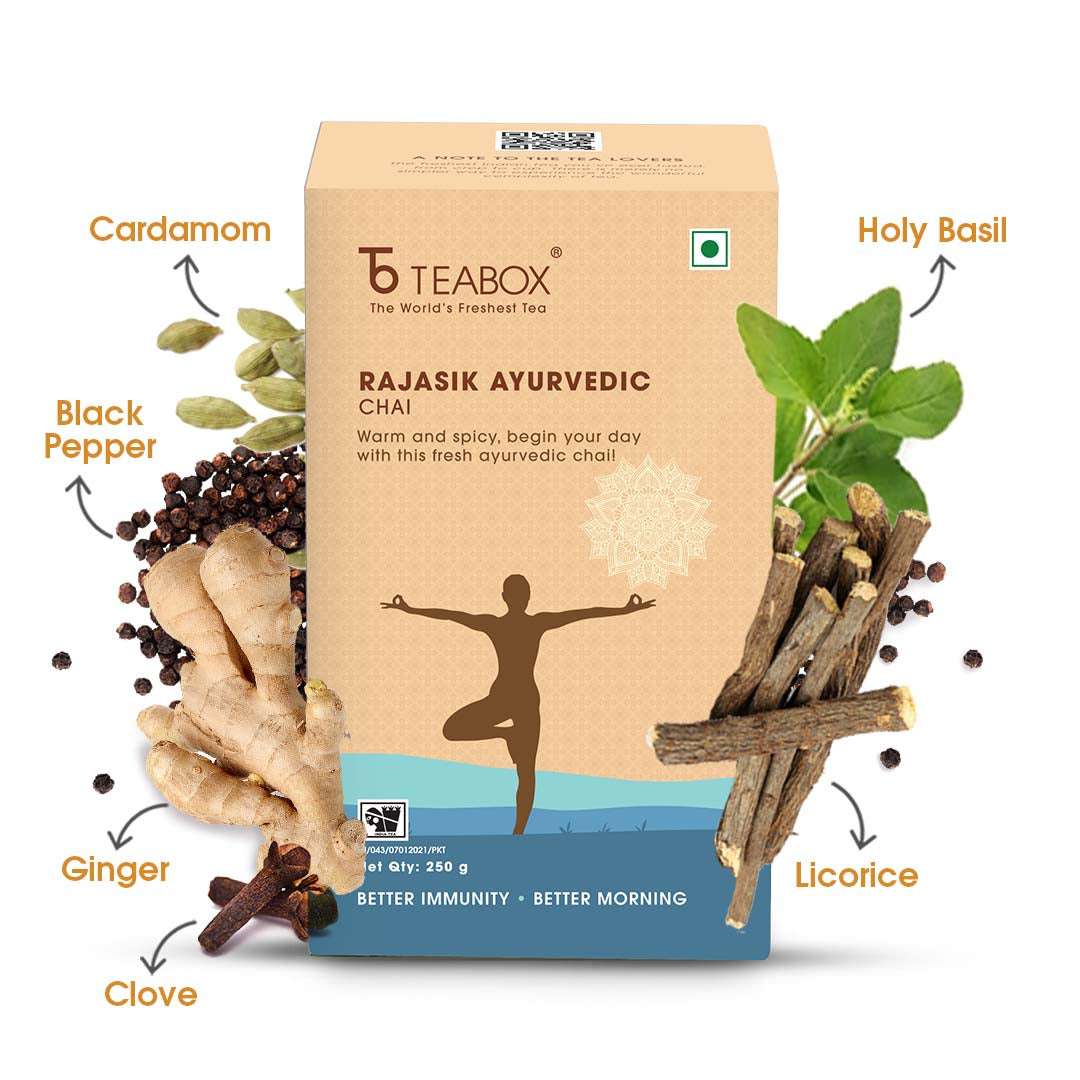
- Rajasik Ayurvedic Chai: our tasting note says it “starts on a sweet-herbal feel on the palate,” with an aroma of black pepper, ginger and holy basil “followed by hints of green cardamom,” and a finish of “earth-woody notes of licorice and black pepper.”
- Turmeric Ginger Tulsi Green: the aroma is “earthy-herbaceous; marked by lifted notes of holy basil,” the taste has “sweet-herbal undertones of holy basil interlaced with warm tones of ginger,” and the cup is yellowish-green.
From our first tulsi chais
Our 2016 notes on the 2014 tulsi chais show how tulsi changes with the base. Masala Indian Chai blended cinnamon, ginger, cardamom, black pepper, clove, mace and nutmeg with tulsi “in a black tea base,” for “a sweet, woody note.”
Tulsi Green Chai opened with “notes of dry wood and tulsi.” As we wrote then, “Tulsi lends a strong flavor and warmth to the tea, while vegetal notes from the green tea gently make an appearance.” In a light green tea, in other words, tulsi leads and the tea follows.
Our flavor coding from 2014 says the same in shorthand: Tulsi Green Chai was marked high intensity, with tulsi as its vegetal note and a tangerine-colored liquor, and the herb-only Tulsi Ginger Chai was coded “tulsi, mint,” with a yam-orange liquor.
Is tulsi the same as basil?
No. Tulsi and the sweet basil used in Italian cooking are close cousins in the same plant genus, Ocimum, but they are different species with different flavors.Read more
Sweet basil (Ocimum basilicum) is sweet and anise-like, made for pesto and tomatoes; tulsi (Ocimum tenuiflorum, also listed as Ocimum sanctum) is peppery and clove-like. Thai basil is another basilicum variety, with a licorice note.
You can make a pleasant infusion from sweet basil, but it will not taste like tulsi tea. Tea 101 suggests steeping a single basil leaf in a pot of green tea for the “zesty” flavor it brings, a lighter, brighter effect than tulsi’s warmth.
India has more basils than one, too. In Assam, the Singpho people forage an herb they call matangban, a basil, and our writer tasted it in a pork stew “lemony with a hint of basil and chilies.” The Singpho story is in Assam Diaries: Margherita, the Singphos and Coin Tea.
Keep reading
Sources
- Teabox blog: How to Make Lemongrass Tea (2015), The Science Behind My Ginger Chai (2015), Assam Diaries: A Day at Majuli (2016), Nostalgia in a Spray (2016), Assam Diaries: Margherita, the Singphos and Coin Tea (2016), The Art of Wellbeing (2020), The Journey of Our Beloved Chai (2020), The Authentic Indian Chai Experience (2023)
- Teabox blog (Still Steeping): “Natural” teas: The rewards, the risks and the watch-outs!, 2016; Ancient Remedies in Modern Times: Ayurveda and Yoga, 2020
- Teabox Tea 101: Chai, the Indian way of drinking tea, Flavored blends; caffeine figures from the Tea 101 caffeine posts
- Teabox product records (descriptions, ingredients, tasting notes, brewing and FAQ fields), October 2026: Rajasik Ayurvedic Chai, Turmeric Ginger Tulsi Green (Teabags), Abhay Ras Chai, Soma Ayurvedic Chai, Ayurvedic Chai Trial Pack
- Teabox Drive: Teabox internal document (2014 SKU records and 2021 tea descriptions); Teabox internal document, 2016; Teabox internal document (blending unit records, 2018 to 2019); Teabox internal document, 2026; Teabox internal document, 2026; photos Teabox internal document, Teabox internal document, Teabox internal document
- Teabox on Instagram (@teabox.tea): Basil Twirl, Apr 2016, Be CALM, Jan 2019, Gaja Indian Heritage box, Oct 2021, Rajasik, Nov 2024, winter Ayurvedic chais, Dec 2025
- Standard botanical and cultural references for tulsi’s species, types and customs (flagged for review in the notes)


Leave a comment
All comments are moderated before being published.
This site is protected by hCaptcha and the hCaptcha Privacy Policy and Terms of Service apply.