


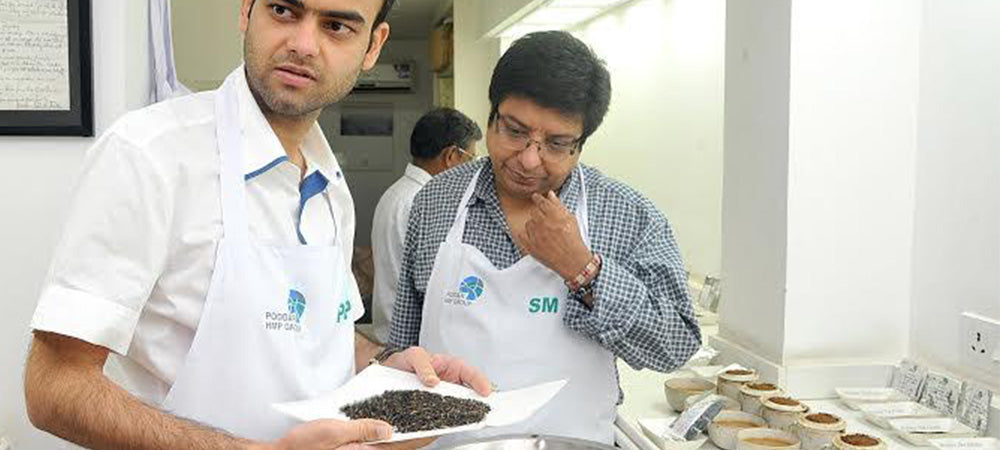
Type by type, Chinese teas tend to be softer and more mellow, and Indian teas more intense and fragrant, with black tea the style where India shines. The plant, the place and the way the leaf is made all play a part. Below, each type in turn, with the teas we would put side by side to taste it.
How does Indian green tea compare with Chinese green tea?
Chinese green teas are usually light to medium bodied and soft; Indian green teas tend to be more intense and fuller in flavor.Read more
The difference comes mostly from how the leaf is “fixed,” the heating step that stops it oxidizing and keeps it green.
How China fixes its greens
Most fine Chinese greens, such as the flat-leafed Longjing (Dragon Well), are pan-fixed slowly, for two to three minutes. That gives the leaf time to release its aromatic compounds, and the cup is gentle and mellow, often toasty or nutty. Japan takes another route, fixing its leaf with steam for a very short time, which gives its greens their grassy, marine character.
The Chinese kit ranges from the home-made to the industrial. As Adeline Teoh explained for our blog, “Small batches are often heated by hand in a vessel like a large wok, but larger batches may be twirled with a broom in a special tub the size of a washing machine drum or in a cylindrical machine similar in size to a phone booth.” Prized “famous” teas such as Longjing and the curly Bi Lo Chun (spring snail) are still largely plucked and made by hand.
China’s range is wide because its growing areas are. Even within one province, Anhui, “the long spear-like leaves of the slightly spicy taiping houkui differ in both form and flavor from the furry tips of the sweet and fresh vegetal Yellow Mountain maofeng.”
Japan’s steamed alternative
Japan’s steaming method dates from 1738, when the tea producer Soen Nagatani invented it. Because steamed leaf keeps more moisture, Japanese green tea “often undergoes three or more periods of drying compared to one or two for Chinese greens.” The result is a vivid green leaf with marine, herbaceous notes, against the yellower leaf and vegetal, nutty, floral taste of a Chinese green. Read A short lesson on Asian green tea.
How India makes green tea
In India the leaf is generally fixed in hot metal pans or drums, and a few producers steam it to make a Chinese-style tea. Every Indian tea region makes some green tea, but the most noteworthy come from the Nilgiris, Assam and Darjeeling.
At Namring in Darjeeling, Sumon Majumder described a green tea made by “steaming the leaf and not fermenting it,” with only a light rolling, and told our blog that “Namring’s green tea is one of the finest.” Some Indian makers borrow China’s scenting craft as well: Peter Keen found that “Indian Nilgiri and Darjeeling producers are using jasmine in their green teas in their search to enhance fine leaf rather than add taste to a so-so base.”
In the Nilgiris, Glendale, a garden established in 1835 and set at 5,000 to 6,500 feet, makes a twisted-leaf autumn green with “refreshing green notes balanced by subtle, sweet undertones”: our Nilgiri Glendale Autumn Twirl Green. The estate makes it from “carefully selected tea clonal cultivars.” More in What is green tea? and Indian green tea.
How does Indian white tea compare with Chinese white tea?
Chinese white teas are extremely light and mellow, valued more for their velvety texture than for flavor; Indian white teas are more fragrant, with floral notes in Darjeeling and fruity ones in the Nilgiris.Read more
White tea comes from China, and the best still comes from Fujian province, made from young spring buds, with or without the first leaf. Silver Needle (Bai Hao Yin Zhen) and White Peony (Bai Mu Dan) are known for their soft, velvety texture and mellow sweetness, and are sought out by tea lovers all over the world.
At the top sit the “moonlight” whites. Peter Keen, writing for our blog, ranked China’s white teas “Moonlight, Silver Needle, White Peony, and Shou Mei,” and traced the name to “the tradition in Yunnan of harvesting the buds under the light of the moon,” when “around 30% will be unopened.” In Yunnan the term covers very large leaf from ancient trees, often pressed into “bing” cakes like a pu-erh.

India’s whites
India now makes both styles, mainly in Darjeeling and the Nilgiris. These are biodiversity-rich hills, and the cool mountain air and rich soils give the leaf a markedly fragrant profile. Darjeeling’s best whites are made in spring, right at the start of the first flush, with notes of citrus blossom, lavender, geranium, tropical fruit and fresh greens. The Nilgiris make their finest whites in winter, with lifted notes of tropical fruit; see Winter and frost teas from the Nilgiris.
Keen was frank about the Darjeeling moonlights. There, he wrote, the name is “a fairly overt marketing claim: the mix of buds and leaf, harvesting, drying and expert judgment.” But the tea is “surprisingly full in taste, with none of the watery blandness that is found in very delicate China greens.” Read Moonlight Sonatas: The Great White Teas.
Our own tasters find each garden’s moonlight distinct. In our 2017 tasting notes, a Margaret’s Hope moonlight showed “Hints of lemon, lily, sweet earth,” and a Castleton moonlight “Hints of geranium.” Castleton still makes “a limited batch of its exquisite Moonlight White Tea” every summer, our Castleton Summer Moonlight White, and Margaret’s Hope a spring one, our Margaret’s Hope Spring Moonlight White.
Two to compare with a Chinese Silver Needle: our Darjeeling Special Spring Silver Needle White, buds plucked at first light in gardens between 4,000 and 5,500 feet, and the Badamtam Spring Moonlight White, with notes of geranium, white lilies, raw mango and a hint of muskmelon, from an estate established in 1858 and “especially revered for its ethereal Moonlight white teas.” More in What is white tea? and Indian white tea.
How does Indian black tea compare with Chinese black tea?
Chinese black teas tend to be smooth and mellow, some sweet and some smoky; Indian black teas run from bold and malty in Assam to light, floral and fruity in Darjeeling.Read more
Black tea is where India shines.
China’s “red” tea
Black tea was first made in China, in the Wuyi mountains of Fujian. In Chinese it is called hong cha, red tea, after the color of the cup, and “black tea” there means dark, aged teas such as pu-erh. Keemun is one of the best-known Chinese black teas, and Lapsang Souchong is dried over pine smoke, which gives it a strong smoky flavor.
Keemun is also the Chinese tea most Western drinkers have tasted without knowing it. In a classic English Breakfast blend, Peter Keen wrote for our blog, Assam brings “fullness and maltiness” and Keemun “a lighter, smoky overtone,” and “Keemun signals a superior tea.”
India’s black teas
India makes black tea from both plants. Assam’s native bushes give bold, malty, full-bodied teas that love milk, such as our Classic Assam Black, with yellow raisins, date palm and stone fruit. Darjeeling’s Chinary bushes give lighter teas that move from floral in spring, like Castleton Spring Chinary Black (brisk citrus, raw mango and orchid), to grape-like muscatel in summer. The Nilgiris make bright, fragrant black teas.
Our training deck gives the flavor families our team works with: Darjeeling’s second flush as “Muscat grape, burnt wood, fruity,” and Assam as “Robust, Full-bodied, Malty, Hint sweet.” Castleton’s spring tea comes from heritage China bushes on a garden founded in 1885. Read What is black tea? and What is first flush tea?
How does Indian oolong compare with Chinese oolong?
Oolong belongs to China; India makes very little, almost all of it in Darjeeling, and on the black tea method, so Indian oolongs taste closer to a fine Darjeeling than to a Taiwanese high mountain oolong.Read more
It comes from Fujian, with the Wuyi mountains and Taiwan as its classic homes, and Chinese drinkers brew it gongfu style, with more leaf in a small pot and many short steeps. Frank Miller, writing for our blog, traced Taiwan’s oolong back to Fujian: “In the mid-18th century, Fujian immigrants, including pioneering tea-makers, crossed the shallow Taiwan Strait,” bringing their bushes and skills with them.
How Darjeeling learned oolong
India makes very little, almost all of it in Darjeeling. Its oolong began at Namring, where Sumon Majumder started “experimenting with Formosa oolong in a bid to develop a ‘Darjeeling variety’,” and called the result “Darjeeling Oolong.” He later introduced it at Singbulli and Balasun for export. Read Meet the man who created the Darjeeling oolong.
When we sent Miller five of our Himalayan oolongs to compare with Taiwan’s, he found them “very tippy, artfully twisted into long, slender spider legs,” and “highly fermented (80%) as oolongs go.” He believed “India and Nepal oolongs are turned out using the orthodox black tea template with tweaks at the withering stage and at fermentation,” and called them, fondly, “Darjeelongs.”
Indian oolongs to try
Our Glenburn Spring Moonshine Oolong is a good example: white blossoms and succulent fruit on a soft, refreshing body. This year’s lot is a first flush tea from Glenburn’s AV2 clonal bushes. Further east, when we launched a spring oolong from Donyi Polo, the first tea garden of Arunachal Pradesh, we described its light, smooth, creamy cup as “remarkably similar to the famed Taiwanese oolong.”
See What is oolong tea? and Indian oolong tea.
Keep reading
Sources
- Teabox Tea 101: Indian vs Chinese teas; Overview of the tea industry in India; Tea producing regions
- Teabox blog: What Became of the Small Leaf Tea? (Ian Bersten, 2015), At a fast clip: Shipping tea from China (Peter GW Keen, 2017), English Breakfast: The Baseline Black Tea (Peter GW Keen, 2016), An Homage to a Box of Tea: Musings of an Art Historian (Romita Ray, 2016)
- Teabox blog: Assam Diaries: Margherita, the Singphos and coin tea (2016), In Kangra, for a tour of the tea gardens (2017), Meet the man who created the Darjeeling oolong (2015), India vs. Taiwan: The Oolong Challenge (Frank Miller, 2017)
- Teabox blog: A short lesson on Asian green tea (Adeline Teoh, 2017), Jasmine Teas: A Scent of Perfection (Peter GW Keen, 2016), Moonlight Sonatas: The Great White Teas (Peter GW Keen, 2016), The finest cup of tea in Beijing (Zac O’Yeah, 2017)
- Teabox blog (Still Steeping): Roll Britannia: the early history of machinery in tea making (Peter GW Keen, 2016); Why Tea Is a Religion and Coffee Isn’t (2015); What’s selling at the Sydney Tea Festival? (2015); People Who Love to Drink Tea From Morning to Evening (Zac O’Yeah, 2016); Black tea: All you need to know (2014)
- Teabox internal documents (Google Drive): Teabox internal document, 2023; Teabox internal document, 2017; Teabox internal document, 2016; photos as credited
- Teabox product tasting notes, estate descriptions and product data, 2026: Nilgiri Glendale Autumn Twirl Green, Special Spring Silver Needle White, Badamtam Spring Moonlight White, Castleton Summer Moonlight White, Margaret’s Hope Spring Moonlight White, Classic Assam Black, Castleton Spring Chinary Black, Upper Namring Spring Clonal Black, Glenburn Spring Moonshine Oolong
- Kausshal Dugarr on X (@Teapreneur): India and 25% of the world’s tea, Jun 2020, Delhi hotel tea, Dec 2016
- Teabox on Instagram (@teabox.tea): How tea was brought to India, Jan 2022, Donyi Polo spring oolong, May 2019; Teabox on YouTube: True Story of Tea Cultivation in India


Leave a comment
All comments are moderated before being published.
This site is protected by hCaptcha and the hCaptcha Privacy Policy and Terms of Service apply.