


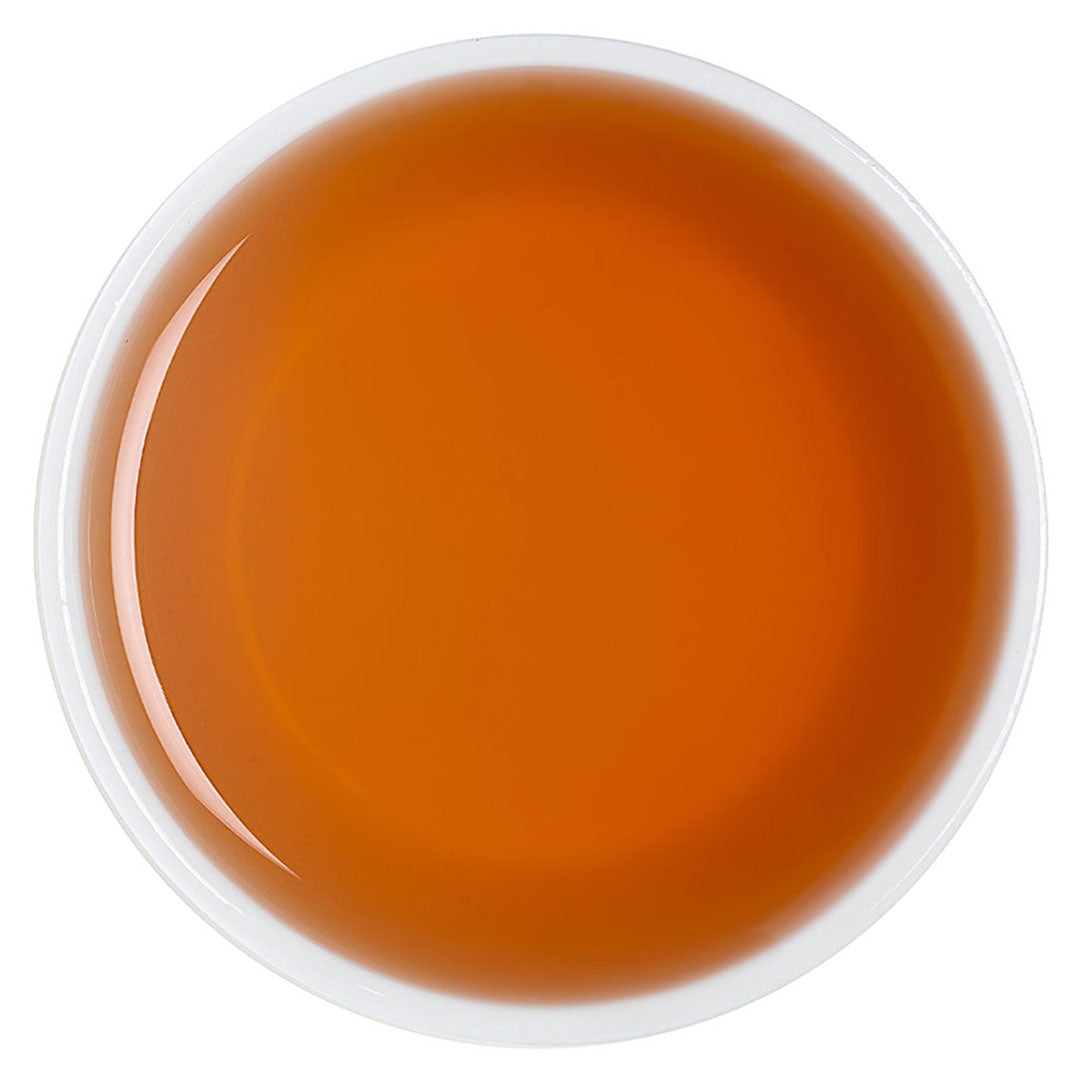
Three things change between spring and summer: the leaf itself, the weather it grows in, and how the tea maker handles it. All three push spring toward light and floral, and summer toward full and fruity. On top of the season sits the year: the same garden can make a weak spring and a brilliant summer in a single year.
How does the season change the leaf?
Spring leaf is small, slow-grown new growth after a long winter rest; summer leaf grows faster in warmer weather and is larger and more mature.Read more
Through the cold, dry winter the bushes rest. Our product pages put that dormancy at December to February, and describe the young spring leaves that follow as “rich in sap.” When spring arrives they push out slow, small, tender shoots, and “the quiet winter months have allowed the leaves to pack in much flavor.” Pickers take two leaves and a bud.
Spring reaches the gardens from the bottom of the hills up. When the Tea Board of India opened the gardens for plucking on 27 February 2023, day temperatures in the lower gardens were “just about touching 17-18 degree Celsius,” and most of those estates had started making tea. Above 4,500 feet it was still colder, and those estates “will usually wait till 10-12th of March till Holi” before making their finest batches.
By late May the bushes have rested briefly again and grown a new flush in warmer weather: larger, more mature leaf that gives a darker, fuller cup with less of spring’s sharpness. Summer also yields more tea than spring.
Our 2017 training notes put rough numbers on a garden’s year: about 18% of its tea is made in spring, 20% in summer, 12% in autumn and 50% in the rains. We buy only in spring, summer and autumn.
A summer visitor
Summer also brings an insect. Our 2019 muscatel notes describe the jassid, a tiny leafhopper, feeding on the young summer leaf and drawing out moisture: “This loss of moisture does not kill the leaf but rather stunts its growth leading to a concentration of flavors.” Its feeding also leaves pinpricks on the leaf that start it browning before it is even plucked. Careful processing then turns that leaf into the muscatel flavor; the full story is in Darjeeling muscatel tea.
How is first flush made differently from second flush?
Spring leaf is handled gently, lightly rolled and oxidized only briefly; summer leaf is oxidized for longer, and the best muscatels get a short wither and a long oxidation.Read more
Spring leaf is handled gently: lightly rolled and oxidized only briefly, so much of it stays green. That is why a first flush Darjeeling, though sold as black tea, can taste closer to a light oolong. Summer leaf is oxidized further, which turns it brown and brings out riper, rounder flavors.
For the best muscatels, the leaf gets a short wither and a long oxidation. Our 2019 notes say these segregated leaves “have to be fired just right, ‘cooked to perfection’,” and warn that “A novice can ruin freshly plucked, good chinary leaves by treating them like an ordinary tea.”
The steps are the same in both seasons; only the timing changes. Darjeeling tea makers adjust that timing all year. Veena Chordia, who came to Darjeeling from the Nilgiris and worked with our procurement team, noticed it at once: “Unlike the Nilgiris, here every flush demands a different manufacturing pattern.” Arun Kumar Gomden, the veteran Darjeeling tea maker and master taster, learned “withering and treatment as per flush time” from his father.
The spring style itself has changed. Gomden recalls that in the 1970s first flush teas “used to be very heavy kinds of teas, strong on the palate with full body. This all changed gradually over a span of a decade.”
Spring making is also a matter of hours. In March 2022 our team spent 24 hours overseeing the making of our first tea of that year’s first flush. About 220 to 230 kg of fresh leaf, only two leaves and a bud, was plucked for the batch, and the work began at 10 am, because morning plucking gives better tea.
For each step in detail, see Tea making step by step.
Does the tea bush change the flavor?
Yes: both seasons come from the same plant, but Chinary and clonal bushes, and old and young sections of a garden, each give a different spring and summer cup.Read more
Both seasons come from the same plant. Most of the teas in this guide are Chinary, from bushes grown from Chinese seed, which give Darjeeling its classic floral spring cup; clonal bushes, bred from cuttings, often taste fruitier (see Chinary, Assam and clonal tea plants).
Gomden puts the difference this way: Chinary flavors “differ significantly from place to place. Clonals, on the other hand, more or less produce the same flavor profiles, with varying intensities dependent on altitude.” That is why a Chinary spring and summer pair from one garden shows the season so clearly.
Old bushes matter most in summer. Our 2023 summer outlook expected an exquisite muscatel harvest if estates could “manufacture from vintage Chinary bushes (which are more than 80-100 years old).” Muscatel, for example, appears only in certain sections of certain gardens, in a window of about two weeks around June.
Inside the leaf, the season changes the chemistry. One of our writers described the gap between “a Darjeeling first flush versus the subtly different second flush harvest from the very same bushes, just a few months apart” as “Same lab, different chemistry.”
Why does each year’s flush taste different?
Because rain, heat and garden upkeep change from year to year, a strong spring can be followed by a weak summer, or the other way round.Read more
No two years are alike. 2022 showed it plainly.
“After sampling over 1,578 cups in the past month, I concur that the First Flush (FF) ’22 doesn’t compare to the quality of the past few years. In terms of quality and flavor, it lacks the soul of Darjeeling teas.”
He traced the weak spring to “the dire need for upkeep of the gardens with proper pruning or skiffing.” Four months later, the same year gave a different verdict: after “a short spring, early summer, and heavy floods,” the 5,456 summer cups our team sampled told “an entirely different story.” A poor spring does not mean a poor summer, which is one more reason to judge each flush, and each year, on its own.
The next two springs went opposite ways. In 2023, “The quality period lasted till about 20th April,” after which hot, humid days with no rain brought on an early banjhi, a spell when the bushes stop putting out new buds. In 2024 better weather let the estates recover, “extending the season late into May with quality yields.”
Sometimes a season is lost altogether. In 2020 the lockdowns came during the first flush, and Darjeeling lost about 0.8 million kg of prime spring tea. The pluckers we met at Jungpana in 2015 put the uncertainty simply: “Last year, the rains were bad … Not a good harvest.”
That is why every Teabox tea page gives its picking date: the year is part of what you are buying.
Keep reading
Sources
- Teabox Tea 101: Your complete guide to first flush and second flush teas; Your guide to summer teas
- Still Steeping, the Teabox blog: What’s the fuss about the first flush? (2015); An Indian Summer in a Cup (2015); Conversations from a tea garden (2015); A balancing act in the Darjeeling tea gardens (2015); Why tea always trumps coffee (2014)
- Still Steeping: The beginner’s guide to choosing a Darjeeling (2017); A Nilgiri girl in Darjeeling (2017); The Steep Road Ahead (2020); A Tryst with History (2020); The Muscatel Master (2021)
- Unpublished Teabox stories (not yet on the new blog): The Future of Darjeeling’s Tea (2015); Creating Flavor in Mystical Isolation (2015); The chemistry of tea: a lab, not a leaf (2016); The Delight of Margaret’s Hope (2016)
- Teabox product pages and product data (tasting notes, liquor colors, grades, FAQs, pairings, estate locations, caffeine, milk and brewing advice), 2026 season: Okayti Spring Chinary, Okayti Summer Chinary, Margaret’s Hope Spring, Margaret’s Hope Summer, Giddapahar Spring Chinary, Giddapahar Summer Chinary, Castleton Spring Chinary, Castleton Summer Muscatel, Thurbo Spring Chinary
- Teabox Drive: Teabox internal document (Avishek Mondol, procurement, Mar 2023); Teabox internal document (Jun 2023); Teabox internal document (Jun 2024); Teabox internal document (Jul 2019); Teabox internal document (2024 to 2026 single estate launches: picking dates, launch dates, FAQ copy); Teabox internal document, 2020; Teabox internal document, 2017; Teabox internal document, 2016
- Teabox product listing photographs (Okayti spring and summer: Teabox internal document, Teabox internal document, Teabox internal document, Teabox internal document) and Teabox internal document, Teabox Drive
- Teabox on Instagram (@teabox.tea): Kurseong estates, Mar 2021, Jungpana spring clonal, Mar 2021, 2.5 g samples, Apr 2021, amber, Jun 2021, Jungpana summer muscatel, Jul 2021, Giddapahar customer, Aug 2021, Badamtam color, Mar 2022, spring scoring, Apr 2022, brewing first flush, May 2023
- Kausshal Dugarr on X (@Teapreneur): liquor quiz, Jul 2020, quiz answer, Jul 2020, first tea of First Flush 2022 and its batch, Mar 2022, First Flush 2022 verdict and its cause, May 2022, Second Flush 2022, Sep 2022
- Teabox on YouTube: What is a flush?, Different Indian tea flushes, Margaret’s Hope x Teabox


Leave a comment
All comments are moderated before being published.
This site is protected by hCaptcha and the hCaptcha Privacy Policy and Terms of Service apply.