


Temi is no longer alone: smaller boutique gardens have been planted in Sikkim since the turn of the century, and the best known of them is Bermiok. It is a small organic garden in the highlands of Sikkim, run by one family and worked largely by women from the village around it. This page covers how it began, how its tea is made, the woman who leads its factory team, and the Bermiok teas we have offered.
How did the Bermiok tea garden start?
Bermiok was started by Tashi Densapa, a retired civil servant known as the Bermiok Rinpoche, and his family, who decided in 1999 to plant tea on their land at Bermiok, put in the first bushes in 2002 and 2003, and began making tea commercially in 2008.Read more
Bermiok was started by Tashi Densapa, a Buddhist reincarnate known as the Bermiok Rinpoche. In the family’s own account, written for us in 2020, the aim was “the first professionally managed private tea estate in Sikkim.”
It was slow work. The family writes that it took two years just to make the land fit for planting, and that “in 2002-03 we planted 100% high variety Darjeeling clonal teas.” Clonal bushes are grown from cuttings of chosen parent plants, so every bush in a section behaves alike. Young bushes need years before they can be plucked for fine tea, and Bermiok made its first commercial tea only in 2008, in its own micro factory. We have called it one of the youngest estates in the country.
Bermiok is run by Nikhil Pradhan, who co-owns the garden with his wife, Dolka. Dolka is Tashi Densapa’s daughter, and Nikhil, his son-in-law, is “a veteran tea planter’s son” who left a career in global consulting for the garden. In June 2020 Nikhil joined our founder for a live “Meet the Growers” session as owner of Bermiok.
To see how Bermiok fits beside Temi, the state’s older and far larger garden, read The Temi tea garden.
What is Bermiok like, and how is its tea made?
Bermiok is a small, organic, family-run garden at 2,500 to 3,200 feet in the highlands of Sikkim, much lower than Temi, and it makes its tea in small, hand-sorted batches.Read more
It sits at 2,500 to 3,200 feet in the highlands of Sikkim, much lower than Temi, and its climate gives teas “rich in aroma and woody in taste.” It is known for its care for the environment and for the women who work there.
It is spread over 15 acres. Our 2019 supplier records put its crop at about 1,500 kg of tea a year, made by around 40 workers. Temi, by comparison, makes about 100,000 kg.
How the family makes its tea
The family describes a garden run with outside experience and local hands.
- Advisers: retired planters with more than 100 years of experience between them guide the estate.
- Small batches: the tea is made in small lots and sorted by hand, so each batch can be judged on its own.
- The workforce: local women are, in the family’s word, “the backbone” of the garden.
- Organic standing: the garden says it is certified by the Sikkim Organic Mission and recognized by the Tea Board.
- Buyers: it sells direct, “working closely with innovative tea traders like Teabox.”
Who makes the tea at Bermiok?
Bermiok’s tea is plucked and made mostly by women from the surrounding village, and its factory team is led by one of them, Kalpana Subba, who started at the garden as a plucker.Read more
One of those women is Kalpana Subba, who started at Bermiok as a plucker and rose to lead the team in its tea factory. When we met her in 2021 she had worked in the garden for eight years, eight hours a day. “Everything that you see, as far as your eyes travel, I know them well,” she told us. “I wanted to know more, about how tea is made, and what is done. And I got the opportunity.”
Her story is told in full in A Day in the Life: Kalpana from Bermiok, written by our team on a rainy morning in the garden during the 2021 lockdown. A few details from it:
- Her start: she studied until class 5, and her parents spent their working lives as day laborers in the bastee, the local word for village.
- Her day: she wakes at 6, makes breakfast, works eight hours in the garden, and ends her day around 8:30 or 9 at night.
- Her family: she was 33 in 2021, married at 18, and a mother of two.
- Her work: her team made Bermiok’s first pickings of white tea, and she said, “I can handle the factory on my own and that brings me pleasure.”
“I wanted to learn how to make good tea, which I am learning and wish to continue,” she told us. Her hopes beyond that were for her children’s education.
Which Bermiok teas has Teabox offered?
We have offered Bermiok teas in several seasons since 2017, an autumn black, a spring oolong and a spring black among them, but no Bermiok tea is in our store today.Read more
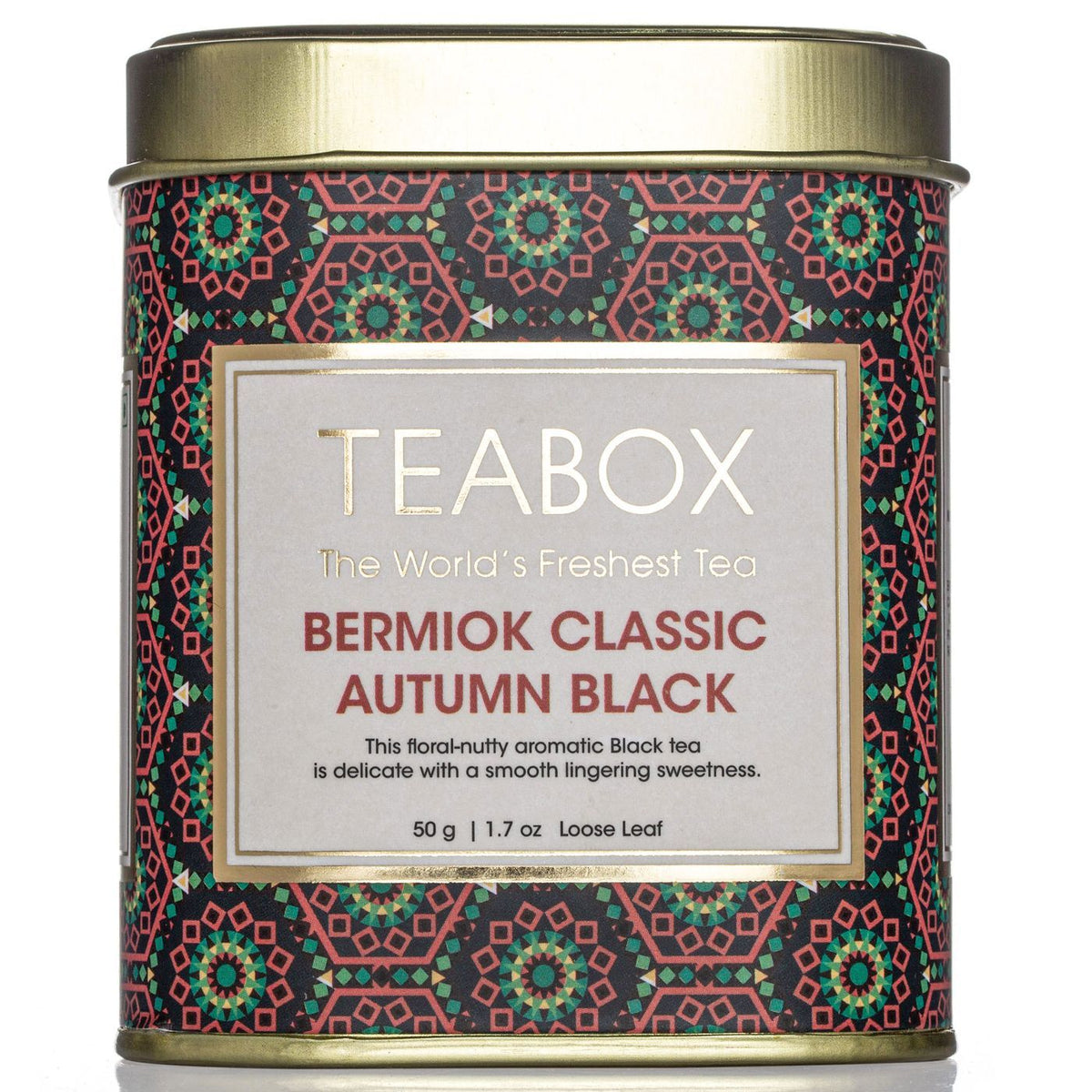
We have offered Bermiok teas in several seasons: Bermiok Classic Autumn Black in 2017 (“immensely smooth, brisk and exceptionally well rounded,” with intense floral notes and a pronounced fruity sweetness), a spring oolong in 2019 and, in 2021, a spring black from mid-elevation clonal bushes, made with a mix of Western and traditional methods to bring out “the woody aromas of the virgin Himalayan forests.”
The 2021 spring black was exclusive to Teabox and came from the first plucking of the season. Those clonal bushes are the high-variety Darjeeling clonals the family planted in 2002 and 2003.
Our visits to Bermiok
Our film crew was at Bermiok on 5 November 2017, in the autumn season. In November 2021 our founder, procurement heads and master tasters spent two days traveling across Darjeeling and Sikkim to sample fresh autumn teas, and Bermiok was one of the gardens on the route, with Goomtee, Jungpana, Giddapahar, Singbulli and Oaks.

For more on how oolong differs from black tea, see What is oolong tea? For Sikkim teas you can buy now, see Which Sikkim tea should you try first?
Keep reading
Sources
- Teabox Tea 101: Sikkim’s Temi Tea Garden: royal with a British connection
- Teabox blog (Still Steeping): A Day in the Life: Kalpana from Bermiok (Mohona Banerjee, 2021), Teatime, Talktime (feat. Anjum Hasan and Zac O’Yeah) (2017), An Indian Summer in a Cup (2015)
- Teabox product data and tasting notes: Sikkim Temi Summer Chinary Black (2022 and 2025 lots), Sikkim Temi Spring Chinary Black (2024 lot), Darjeeling Giddapahar Summer Muscatel Black, Darjeeling Thurbo Spring Chinary Black
- Teabox Drive: Teabox internal document, 2013; Teabox internal document, 2013; Teabox internal document, 2022; Teabox internal document, 2022; Teabox internal document; Teabox internal document; Teabox internal document, 2020; Teabox internal document, 2023; Teabox internal document, 2017; Teabox internal document, 2018; Teabox internal document, 2017; photos as credited
- Teabox purchase and supplier records (internal, not linked): Temi purchase form, November 2014; Temi invoices, April and June 2018; estate supplier sheet, 2019
- Teabox on Instagram (@teabox.tea): Temi visit, Jul 2017, Bermiok autumn black, Oct 2017, Bermiok, Apr 2018, Bermiok spring oolong, May 2019, organic Sikkim and Temi, Jul 2019, Temi founded 1969, Jun 2020, Bermiok founding, Jun 2020, Bermiok elevation, Jun 2020, Temi 440 acres, Aug 2020, Temi summer flush, Aug 2020, Bermiok spring black, May 2021, how Temi began, Aug 2021, Pang Lhabsol, Sep 2021, autumn tasting trip, Nov 2021, Sikkim tea profile, Feb 2022
- Kausshal Dugarr on X (@Teapreneur): Meet the Growers with Temi, Jun 2020, Meet the Growers with Bermiok, Jun 2020, Temi on The Late Show, Jul 2021
- Teabox on YouTube: Masterclass: Sikkim, From The Source: Temi Tea Estate, From The Source: Bermiok Tea Estate


Leave a comment
All comments are moderated before being published.
This site is protected by hCaptcha and the hCaptcha Privacy Policy and Terms of Service apply.